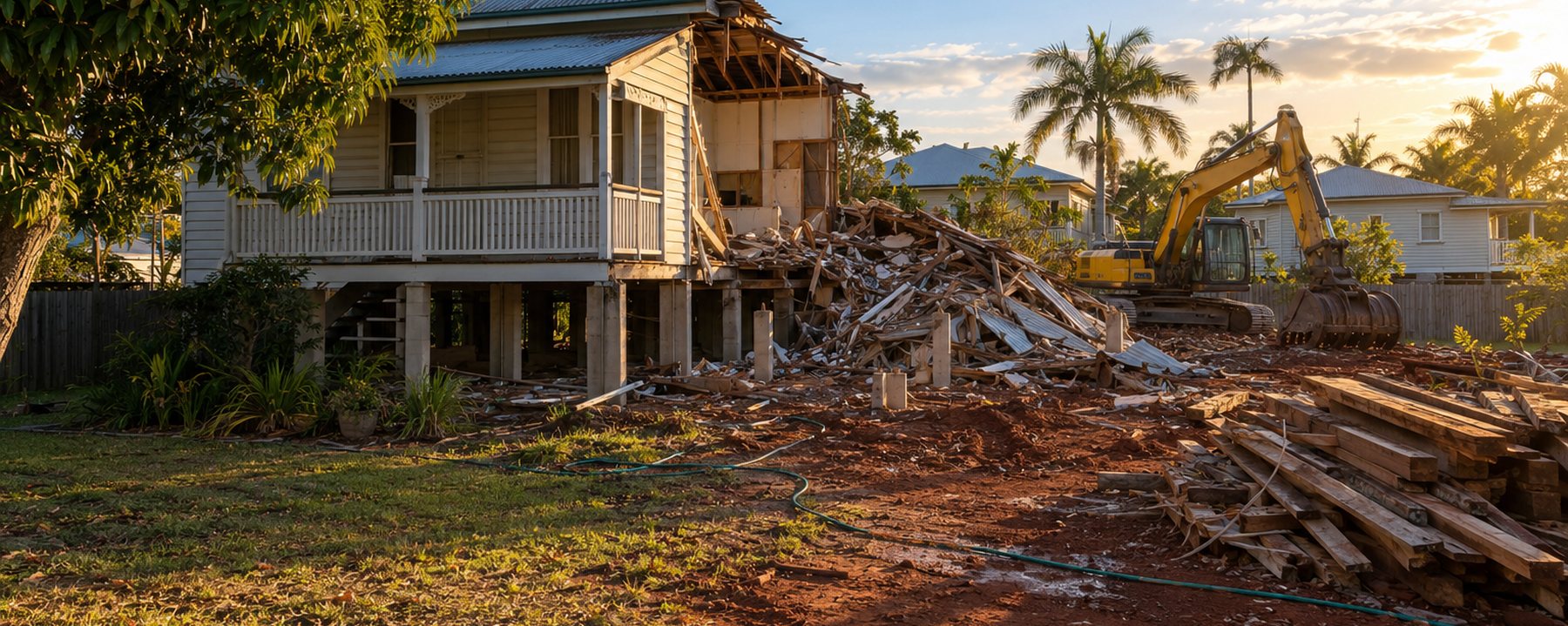
Demolition in Bundaberg, done with the paperwork in order.
Houses, sheds, pools, slabs and commercial buildings taken down and carted away across Bundaberg, Bargara, Gin Gin and Childers.
Licensed demolition and asbestos contractors, a certifier's approval on every job, and the services abolished before the machine arrives.
Tell us what is coming down
The suburb, what the building is (a high-set Queenslander, a post-war fibro, a brick house, a shed, a pool, a slab), roughly when it was built, and how a machine would get to it. A photo from the street and one of the back yard is enough to begin with. If you know there is fibro on it, say so; it changes what gets lodged first.
If a builder is booked to start on the empty block, a sale is waiting, or the house is flood or storm damaged, say that too.
Request a quote
The machine is the easy part. Everything before it is the job.
A house in Bundaberg comes down in a day or two. Getting to that day takes longer: a building approval from a private certifier, because demolition is building work under the Building Act and the council stopped certifying in 2015; a check of the heritage and character overlay, because the older timber-and-tin streets around the centre and in Childers need a planning application before a Victorian, Federation or Interwar house can go; an asbestos survey, because WHSQ presumes asbestos in any building built before 31 December 1989 until a sample shows otherwise; and the electricity, water, sewer and gas properly abolished, not just turned off, with Ergon's written confirmation in hand.
The contractor who does the pulling down is licensed by Workplace Health and Safety Queensland, not by QBCC, and any machine job on a house needs that licence. Anything with asbestos over ten square metres needs a licensed removalist, five days' notice to WHSQ and a clearance certificate before the excavator arrives. The pages here cover both halves: the trade, and the rules that sit around it in this region.
Permits and licences for demolition in Bundaberg, in plain English
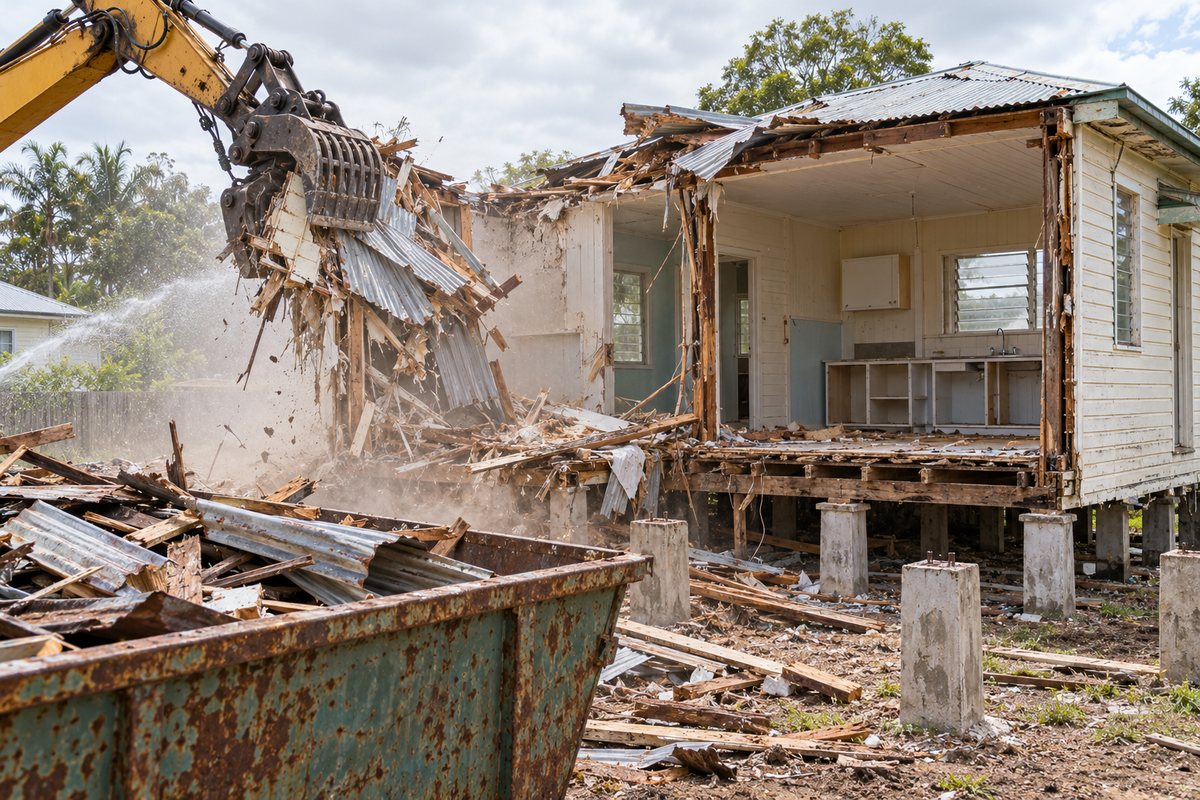
Eight reasons a Bundaberg building comes down
Most of them start with a builder, an insurer or a council letter rather than a wrecking ball.
- Knock-down rebuildA post-war fibro in Kepnock or Avoca on a big block, worth more as bare land with a new house on it than as a renovation. The builder wants a clear, level site with the services capped.
- Flood damageHouses on the North Bundaberg flats and along the Burnett have been through 2010, 2013 and March 2026. Some were raised. Some are past it, and the insurer or the owner has decided.
- The fibro has had itAsbestos cement walls, eaves and fences from the 1950s to the 1980s, cracked and weathering. The removal is licensed work and it is where every demolition here starts.
- Termites got there firstTermites are a problem throughout Queensland, and a timber house that has been eaten through the bearers and studs is often cheaper to replace than to repair.
- A pool nobody usesA 1980s concrete pool in a Walkervale back yard, fenced, filtered and empty most of the year. Breaking it out, filling it and taking it off the QBCC register gives the yard back.
- Sheds, garages and lean-tosThe iron shed at the back, the carport that leans, the farm shed at Gin Gin with the asbestos roof. Small jobs, but the same rules on asbestos and machinery.
- A commercial site changing handsA workshop, a shop, a packing shed or a cane-industry building, with WorkSafe notifications, traffic management and a bigger machine.
- The Queenslander is worth more movedA sound timber house on stumps that someone else wants. Council is a referral agency under its April 2026 policy and no longer requires a bond; ask council or the certifier what supporting reports (typically a structural engineer's report and transport route) the referral needs.
Demolition services in Bundaberg
Each page explains what the work involves, which rules apply to it, and what tends to drive the price.
House demolition
Taking down a whole house, Queenslander or post-war, and leaving a clean, level block ready to build on.
Read more →Asbestos removal
Licensed removal of fibro walls, eaves, roofing and fences before the machine goes in, with the clearance paperwork.
Read more →Strip-outs & partial demolition
Gutting a kitchen, bathroom or whole interior, or removing a wall, verandah or extension while the rest of the house stays.
Read more →Pool removal
Breaking out and filling a concrete or fibreglass pool so the yard can be used again.
Read more →Shed, garage & carport demolition
Pulling down tin sheds, garages, carports and lean-tos, and carting the iron and timber away.
Read more →Concrete & driveway removal
Breaking up slabs, paths, driveways and footings, and crushing or carting the concrete.
Read more →Commercial & industrial demolition
Sheds, shops, farm buildings and cane-industry structures, with the WorkSafe notifications done.
Read more →What it costs
What moves the price of a demolition in Bundaberg, from asbestos to tip fees, and the seven things a quote should spell out.
Read more →Why demolition here is its own job
Four things about this part of Queensland decide how a building comes down and where it goes.
The river. The Burnett at Bundaberg peaked at 9.53 metres in January 2013, the highest on the Bureau of Meteorology's record, with more than 4,000 homes inundated and about 5,000 people evacuated from North Bundaberg. It reached 7.92 metres in December 2010 and went above the 7.40 metre major level again in March 2026. The flood hazard overlay in the planning scheme follows that history, and a demolition on the flats is assessed against it.
The housing. The town was gazetted in 1869 and most of the older streets near the centre, in Bundaberg East and South and in Childers are high-set timber Queenslanders. The suburbs that grew after the war, Walkervale, Kepnock and Avoca, and Avenell Heights from the late 1960s, are broadly fibro and then brick. Eighty-five per cent of the region's dwellings are separate houses. That mix is why nearly every job starts with an asbestos survey and why so many timber houses are moved rather than crushed.
The ground. From The Hummock through to the coast the Woongarra soils are deep red volcanic loam, easy digging and free draining. The river flats are grey alluvial clays that hold water. The coastal strip below five metres carries an acid sulfate soils overlay. Where a slab or a pool comes out, the ground decides what fill goes back.
The tip. Everything that is not salvaged ends up at a council facility, and the only one in the region that takes asbestos is the Bundaberg Waste Facility on University Drive. From 1 July 2026 demolition waste is $359 a tonne there. The state levy ($135 a tonne in 2026-27) applies to landfill in the Bundaberg region and rises every July; ask council how it is reflected in the gate fee. Sorting on site, salvaging hardwood and iron, and sending clean concrete at $240 a tonne is where the money is saved.
Practical consequence: the cheapest quote on paper is usually the one that has not priced the asbestos, has not sorted the waste, and has not asked who is abolishing the power.
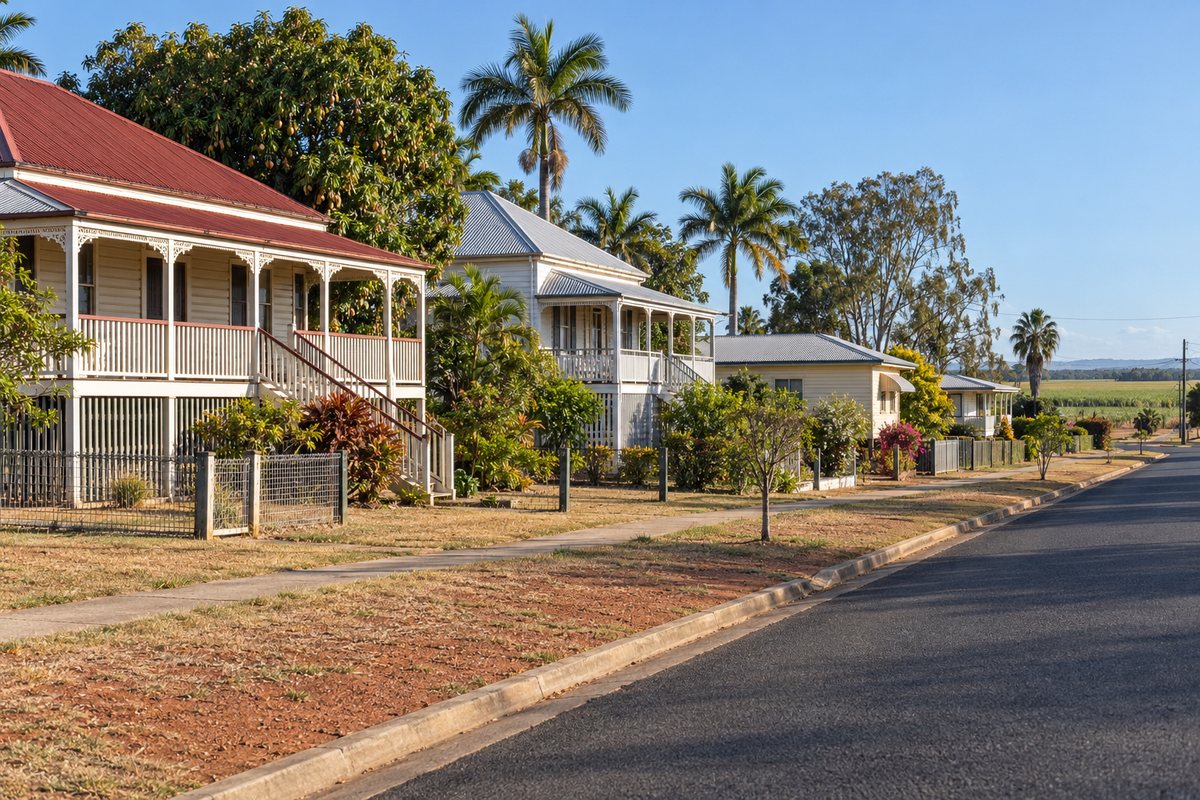
Suburbs and districts covered:
What happens on a Bundaberg demolition
Six steps. The first four happen before a machine is booked.
Photos, the suburb and a walk around
What the building is, what it is made of, how old it is, and how a machine gets down the side. A walk through with a torch and a sample bag finds the fibro, the services and anything worth salvaging. A price range follows.
Certifier and council
A QBCC-licensed building certifier is engaged for the building approval. The overlays are checked from the address. A house in a character area or on the local heritage register goes to council's planners first. The approval sets a clock: start within two months, finish within a year.
Services abolished
You ask your electricity retailer to remove the connection and Ergon takes the service line and meter, up to 20 business days in town. Council staff disconnect water and sewer on application. Gas is abolished or the bottles collected. Nothing starts until Ergon has confirmed in writing.
Asbestos out first
A licensed removalist notifies WHSQ five days ahead, works to a removal control plan, wraps and labels the sheets, and gets a clearance certificate for the site. The asbestos goes to University Drive with its tracking paperwork. Only then is the house ready for the machine.
Salvage, then the machine
Hardwood, iron, windows and anything with a second life come out by hand. Then the excavator takes the building down, sorting as it goes: timber one way, steel another, concrete and brick a third, general waste to the skip.
Stumps, footings, fill and level
Stumps and footings are dug out, any septic or wastewater system is removed, the site is filled where it needs it, graded and left level for the builder. The certifier's final inspection closes the approval.
Two licences, one approval, one register you will not find demolition on
Demolishing a building is building work under Queensland's Building Act 1975, so it needs a building approval, and in Bundaberg that is a private certifier's job: the council stopped certifying in September 2015. Under the Act the demolition must substantially start within two months of the approval and be finished within a year, with one extension of up to six months available from council. The certifier confirms the conditions that apply.
The contractor's licence comes from Workplace Health and Safety Queensland. Any demolition using an excavator, skid steer, loader or crane needs a WHSQ demolition work licence, as does anything with pre-tensioned or post-tensioned concrete or brought down by induced collapse. QBCC lists demolition workers among those who do not need a QBCC licence, so a QBCC number on its own tells you nothing about whether someone can demolish your house. Asbestos removal is a separate WHSQ licence again, Class A or Class B.
Around that sit the council's rules: a planning application for a Victorian, Federation or Interwar house in a mapped character area or for any local heritage place, a road reserve permit if skips or machinery use the footpath or street, and the flood, coastal and acid sulfate overlays where they apply.
Heritage and character rules for demolition in Bundaberg
What a demolition contractor cannot do
A demolition contractor cannot issue the building approval, because that is the certifier's job, and cannot decide a planning application for a house in a character area, because that is council's. A contractor cannot remove more than ten square metres of bonded asbestos or any friable asbestos without the right WHSQ licence, cannot abolish the electricity, because only your retailer can ask Ergon to do that, and cannot disconnect the water and sewer, because council staff do that on application. A contractor also cannot tell you from the street whether the fibro is asbestos; a sample can.
Check the current rules before you rely on this
This page summarises how demolition is approved and regulated in Queensland for Bundaberg region property owners. It describes the rules in general terms as they stood in October 2026. Standards, forms, thresholds and fines change.
The authoritative sources are Workplace Health and Safety Queensland, demolition work licence, Building Act 1975 (Queensland), Bundaberg Regional Council, building and planning approvals, Bundaberg Regional Council, heritage properties and neighbourhood character and Workplace Health and Safety Queensland, asbestos removal licences. Where anything here differs from those sources, they are right and we are not.
We are not building certifiers, engineers, planners or lawyers. For what applies to your property, ask a licensed building certifier or ring Bundaberg Regional Council on 1300 883 699.
Accurate at the time of writing, October 2026. Always check the source before relying on it.
What moves the price of a demolition
Demolition is priced on what the building is made of, what is in it that has to be handled separately, and what it costs to get rid of. In Bundaberg the asbestos and the tip move the number more than the size of the house does.
| Factor | Why it matters |
|---|---|
| Construction | Timber and iron comes apart and much of it is salvage. Brick and block are heavier, slower and all go to the tip by the tonne. |
| Asbestos | Licensed removal, five days' notice, a clearance certificate and $208 a tonne at University Drive. On a 1960s fibro house this is often the biggest single line. |
| Tip fees and levy | Demolition waste $359 a tonne, clean concrete $240, green waste $160, from 1 July 2026. The state levy applies to landfill in the region and goes up $10 a tonne every July; ask council how it is reflected in the gate fee. |
| Salvage | Hardwood, iron, windows and a whole Queenslander worth moving all take weight off the tip bill, sometimes a lot of it. |
| Access | A machine down the side of a Walkervale block is one price. A crane over the house because there is no side access is another. |
| Services | Ergon's fixed fees for removing the service line and meter, charged through your retailer, and council's application for water and sewer disconnection. |
| Approvals | The certifier's fee for the building approval, and council fees where a heritage place or the road reserve is involved. |
| What is left | Stumps, footings, a slab, a septic tank. Taking them out and filling to level is part of the job or it is not, and the quote should say which. |
When you compare quotes, check whether each one names who is doing the asbestos and under what licence, includes the certifier's approval, says what happens to the stumps and footings, and states who is applying for the services to be abolished.
Things Bundaberg owners ask
Do I need approval to demolish a house in Bundaberg?
Yes. Demolishing a building is building work under Queensland's Building Act 1975, so it needs a building approval, and in Bundaberg that comes from a QBCC-licensed private building certifier rather than the council, which stopped certifying in September 2015. If the house is in a mapped neighbourhood character area or is a local heritage place, a planning application to Bundaberg Regional Council comes first. The certifier confirms which applies to your address.
Who licenses demolition contractors in Queensland?
Workplace Health and Safety Queensland, not QBCC. A business needs a WHSQ demolition work licence to pull down anything with an excavator, skid steer, loader or crane, anything with pre-tensioned or post-tensioned concrete, or anything brought down by induced collapse. The only exemption is a domestic house or its carport or garage taken down without any of those, which in practice rules out most machine jobs. QBCC lists demolition workers as not needing a QBCC licence.
Is there asbestos in my house?
If it was built before 1990, assume so until a sample says otherwise. Fibro sheeting, eaves, bathroom linings, vinyl floor backing, fences and some roofing in Bundaberg's post-war suburbs are the usual places. More than 10 square metres of bonded sheeting needs a Class B licensed removalist, a five-day notification to WHSQ and a clearance certificate before the machine goes in. Friable material needs a Class A licence whatever the quantity.
What does demolition cost in Bundaberg?
It depends on what the building is made of, how much asbestos is in it, how a machine gets to it, what can be salvaged, and what the tip charges. Construction and demolition waste at the Bundaberg Waste Facility is $359 a tonne from 1 July 2026, clean concrete $240 and asbestos $208. The state levy ($135 a tonne in 2026-27) applies to landfill in the Bundaberg region; ask council how it is reflected in the gate fee. Electricity abolishment through your retailer adds Ergon's fixed fees. The cost guide explains each line.
How long does it take?
The paperwork is the long part. Electricity removal through your retailer takes up to 20 business days in town, licensed asbestos removal needs five days' notice to WHSQ, and the certifier's approval has its own lead time. Once everything is signed off, a timber or fibro house in Bundaberg is usually on the ground and the block cleared within a few working days. Brick and block take longer.
Can a Queenslander be moved instead of demolished?
Often, and it is worth asking. Timber houses on stumps lift and travel well, and there is a market for them. Council is a referral agency under its April 2026 policy and no longer requires a bond; ask council or the certifier what supporting reports (typically a structural engineer's report and transport route) the referral needs. In a character area the removal needs a planning application, same as a demolition.
Which areas do you cover?
Bundaberg and its suburbs, from Bundaberg East and North Bundaberg out to Kepnock, Avoca, Walkervale, Svensson Heights, Norville, Avenell Heights, Thabeban, Millbank and Branyan, the coast at Bargara, Burnett Heads, Innes Park, Coral Cove, Elliott Heads and Moore Park Beach, and the rural districts around Gin Gin, Childers, Woodgate and Apple Tree Creek.
What happens to the electricity, water and gas?
They are disconnected before anything comes down. Electricity is removed, not just switched off: you ask your retailer, Ergon pulls the service line and meter, and demolition must not start until Ergon confirms in writing. Water and sewer are disconnected by Bundaberg Regional Council staff on application. Gas is either Australian Gas Networks' reticulated supply or LPG bottles to be collected. The checklist page walks through the order.
Send a few photos and a suburb
The building from the street, the back yard, and the access down the side. That is usually enough for a price range before anyone visits.