Why timber Queenslanders get moved
Bundaberg's older suburbs were built in timber on stumps for a reason: the material was local, the climate wanted air underneath, and the river flooded. The same construction that made those houses practical in 1900 makes them movable today. A high-set Queenslander is a timber frame on bearers that rest on stumps. It is not tied to a slab, it has no masonry to crack, and the whole thing can be jacked clear of its stumps and carried off. The removal trade is well established in the Wide Bay.
The economic case is simple. A seasoned hardwood frame, VJ lining, hoop pine floors and a full verandah are expensive to build new and have a ready market as a removal home. If the house is sound, a removalist may take it for little or nothing, or in some cases pay for it, and your block is cleared without a tip fee on the structure. Compare that with demolishing it: labour and machine time to pull it apart, the construction and demolition rate of $359 a tonne from 1 July 2026 for what cannot be salvaged, and the hardwood ending up as a stack of boards rather than a house someone lives in.
There is also a heritage dimension. The Bundaberg Regional Council Planning Scheme 2015 treats the older timber and tin suburbs as neighbourhood character areas, and council's own fact sheet says demolition of a local heritage place is generally not supported. Relocation keeps a character building in use. It is not approved automatically, but it is a more comfortable conversation with a planner than demolition is.
How a house removal actually works
The removalist starts with an inspection of the frame, bearers and joists, roof structure, and whether the house can be cut into sections that fit on the road. A narrow Queenslander can sometimes travel in one piece; wider houses are cut along a line that avoids the main structural members, usually through a hallway, and travel as two or three pieces rejoined at the other end. Verandahs, extensions and anything built in underneath are often removed first.
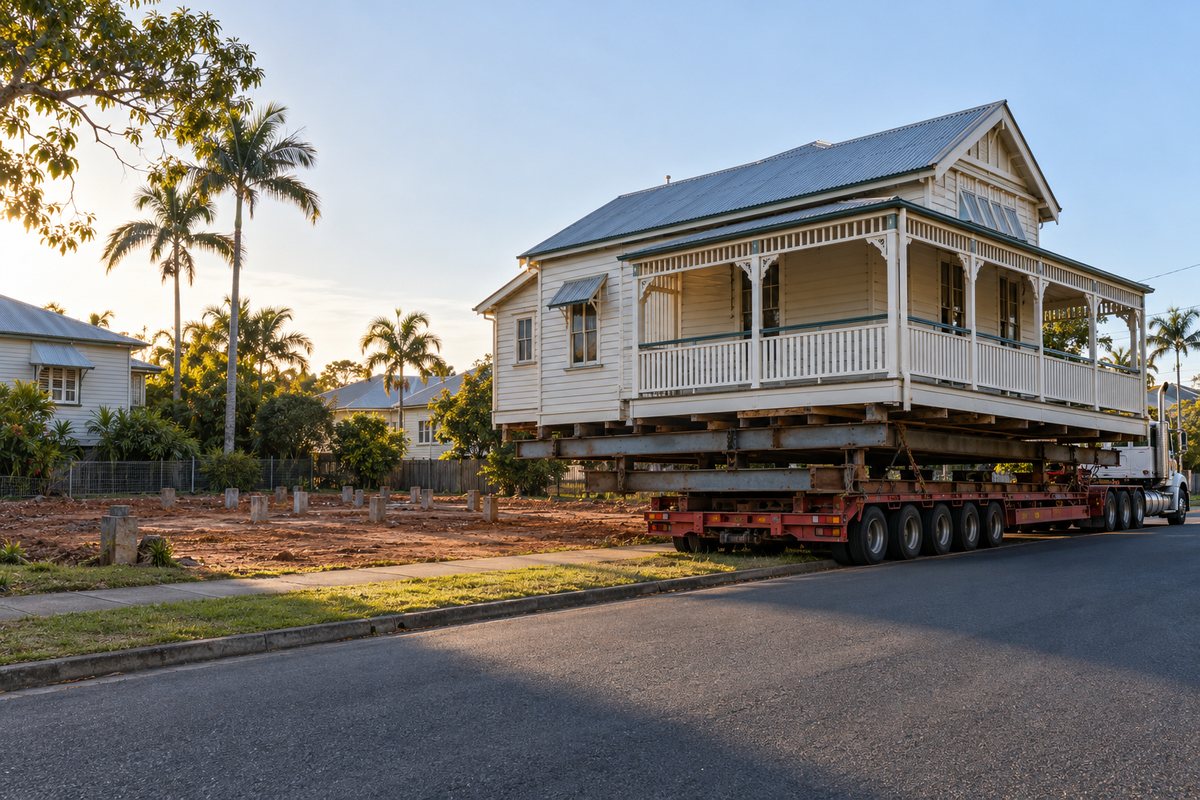
On the day, the house is jacked off its stumps on hydraulic jacks and steel beams are slid under the bearers. Low-loader trailers back under the beams, the house is lowered onto them, and it is driven out. Because the load is over width and over height, the trip is done at night with pilot vehicles front and rear, and the route is planned in advance to avoid low power lines, tight corners and weak bridges. Ergon may need to lift or drop lines along the route, which is part of the transport route planning. The whole lift and load takes a day or so; the planning takes weeks.
What stays behind on your block is the stumps, any concrete footings, the ground floor slab if one was poured under the house, the wastewater system if the property is not on sewer, and whatever sheds, tanks and paths were not part of the removal. Clearing those is a demolition job in its own right, and it is usually where our part begins. The council policy asks for the site to be left clear of debris, stumps, foundations and wastewater systems, so the removal contract and the clearing contract need to join up.
What council asks for under the April 2026 policy
Removing a house is building work under the Building Act 1975, so like demolition it needs a building approval from a QBCC-licensed private certifier. The certifier is the decision maker. Bundaberg Regional Council comes into it as a referral agency: the certifier refers the application to council, which assesses it under its Amenity and Aesthetics and Removal or Rebuilding Policy, version 1, adopted 28 April 2026. A referral fee applies per the council fee schedule; ask council for the current figure.
The policy replaced a 2017 version that required a security bond of up to $20,000 to make sure the site was cleaned up. Under the April 2026 policy applicants are not required to provide a security bond. If a removalist or an old web page tells you to budget for a council bond, that is out of date for the Bundaberg region. Council is a referral agency under its April 2026 policy and no longer requires a bond; ask council or the certifier what supporting reports (typically a structural engineer's report and transport route) the referral needs.
- A structural engineer's report. Typically an assessment confirming the building is sound enough to be lifted and transported, and noting any bracing or repairs needed before the move.
- A transport route. The planned route from your block to the destination (or to the removalist's yard), with the heights, widths, bridges and power lines along the way accounted for.
Where the house is going to a block within the region, the policy also covers the rebuilding side: external works on the relocated dwelling are expected to be finished within 12 months, and the receiving block needs its own approvals. Outside the region, the receiving council has its own rules. The certifier confirms the current conditions.
Clearing the block afterwards
Once the house is on the road, the block is not finished. The policy asks for it to be cleared of debris, stumps, foundations and wastewater systems, and that is a demolition and excavation job. Timber stumps are pulled; concrete stumps are cut at ground level or pulled with their footings. If a slab was poured underneath for a laundry or a built-in area, it is broken out and carted as clean concrete at $240 a tonne (Bundaberg facility only) if it is free of mesh and contamination, or as mixed C&D if not. Septic tanks and trenches on unsewered blocks in places like Gin Gin or the rural fringe are pumped out, broken or removed and backfilled, and a compliance permit from council for disconnecting and removing an on-site sewerage facility applies ($650 for 2026-27).
Services are dealt with as for a demolition: Ergon abolishment through your retailer, with written confirmation before anything is lifted; water and sewer disconnection by council staff on the Notice to Service Provider form; gas through Australian Gas Networks or the LPG supplier; NBN lead-in by quote. The pre-demolition checklist runs through the order. Our clearing service after a removal is described on house demolition in Bundaberg and, for the footings and slabs specifically, concrete and driveway removal.
Character areas and heritage places
Relocation is not exempt from planning. Under the Heritage and neighbourhood character overlay of the Bundaberg Regional Council Planning Scheme 2015, a development application is needed to demolish, relocate or remove a Victorian, Federation or Interwar building in a mapped neighbourhood character area. Those areas cover the older timber and tin suburbs of Bundaberg and the heritage town centres of Bundaberg and Childers. Bundaberg does not use Brisbane's pre-1946 test; the trigger here is the building's era and whether it sits in a mapped area, which council's duty planner on 1300 883 699 can confirm from the address.
A code assessment triggered only by the heritage and character overlay carries no council fee for 2026-27, though the application is assessed against the overlay code. Where the building is one of the region's 79 local heritage places, the position is firmer: removal or demolition needs a development application with a $1,770 council fee for 2026-27, and council's stated position is that demolition is supported only where there is no prudent or feasible alternative. Relocation of a heritage place is assessed on its merits. The full picture is on heritage and character demolition.
When demolition wins anyway
Not every Queenslander is worth moving, and the removalist's inspection is usually where that becomes clear. Three problems in particular tip the balance toward the excavator.
Termites. Termites are a problem throughout Queensland and old timber houses that have sat on untreated stumps for a century are prime targets. Damage in the bearers, joists or wall plates means the house cannot be safely jacked without extensive repair, and a structural engineer will not sign off a lift on a compromised frame. Where the damage is through the main members rather than a few studs, removal is off the table.
Rot. The climate is humid and the older houses on the North Bundaberg and Fairymead flats have been through floods, including the 2013 record peak of 9.53 metres that inundated over 4,000 homes. Bearers that sat in floodwater, posts that have wicked moisture for decades and framing under a leaking valley all weaken the structure. A house that has been under water more than once is rarely a removal candidate.
Asbestos cladding over the timber. A lot of Queenslanders were sheeted in fibro during the post-war decades, over the original weatherboards or in place of them, and lined internally with fibro in wet areas. Removalists will generally not transport a house with asbestos sheeting on it, which means a licensed Class B removal before the move, with a Form 65 notification, a control plan and a clearance certificate. That cost comes out of the house's value, and if the fibro is extensive the removal stops making financial sense. At that point a demolition that handles the asbestos removal first and then salvages the sound hardwood before the machine goes in captures most of what the house had to offer.
There is a fourth, less dramatic reason: the house is not wanted. Removalists take houses they can sell, and a heavily altered Queenslander with its verandahs built in and aluminium windows has less appeal than an intact one. Either way, the first step is the same: get a removalist and a demolition contractor to look at it, and compare. Send through the address and some photos to start.
What this page cannot do
This page cannot tell you whether your house can be moved. That is a decision for a house removalist after an inspection and for a structural engineer whose report the referral will typically rely on. It also cannot tell you whether your block sits in a mapped neighbourhood character area or whether the building is a local heritage place; council's duty planner confirms that from the address, and the certifier confirms the building approval conditions. The April 2026 policy is described as published; council can amend it, and the referral fee is per the current fee schedule. Nothing here is engineering, planning or legal advice, and no removal or demolition should be arranged on the strength of this page alone.
Check the current rules before you rely on this
This page describes how house removal works in the Bundaberg region, what council requires under its April 2026 removal policy, and when demolition is the better option for an older timber house. It describes the rules in general terms as they stood in October 2026. Standards, forms, thresholds and fines change.
The authoritative sources are Bundaberg Regional Council Amenity and Aesthetics and Removal or Rebuilding Policy 2026, Bundaberg Regional Council, heritage properties and neighbourhood character, Bundaberg Regional Council heritage places and neighbourhood character factsheet, Building Act 1975 (Queensland), Bundaberg Regional Council Fees and Charges 2026-27 and QBCC on termites in Queensland. Where anything here differs from those sources, they are right and we are not.
We are not building certifiers, engineers, planners or lawyers. For what applies to your property, ask a licensed building certifier or ring Bundaberg Regional Council on 1300 883 699.
Accurate at the time of writing, October 2026. Always check the source before relying on it.