What gets pulled down along the coast
The strip from Moore Park Beach in the north, through Burnett Heads, Bargara, Innes Park and Coral Cove, down to Elliott Heads, has a different housing story to the city. For most of the twentieth century these were holiday places. The blocks carried beach shacks, fibro weekenders, lightweight timber cottages on low stumps, and later, broadly, the brick holiday units of the 1970s and 80s. Many of those shacks now sit on land worth far more than the building, and the owner wants a new house there.
That is why coastal demolition in the Bundaberg region is so often a knock-down rebuild of a small, old, lightweight building. A fibro beach house from the 1960s is usually a quick job for a licensed contractor with an excavator, but the small size of the building does not make the paperwork smaller. Anything built before 31 December 1989 is presumed to contain asbestos, so the fibro sheeting, the eaves, the bathroom walls and often the old vinyl floor tiles are treated as asbestos until a sample says otherwise. In practice the asbestos removal happens first, as a separate licensed stage, and the excavator arrives after the clearance certificate. Our asbestos removal page explains the Class A and Class B licences and the Form 65 notice to Workplace Health and Safety Queensland.
Coastal protection, storm tide and acid sulfate soils
The Bundaberg Regional Council Planning Scheme 2015 carries twelve overlays, and three of them matter more on the coast than anywhere else in the region. The Coastal protection overlay covers the foreshore land along the whole strip. The Flood hazard overlay has a coastal storm tide component as well as the river and localised flooding parts. The Acid sulfate soils overlay has two areas: Area 1 for land at or below 5 metres AHD, and Area 2 for land between 5 and 20 metres AHD. Low-lying land at or below 5 m AHD, which can include parts of the coast near river and creek mouths, may be in Area 1; check the mapping. You can check which overlays touch a particular lot through the council's planning scheme overlays fact sheet and its mapping.
What does that mean for a demolition? Demolishing a building is building work under the Building Act 1975, so you need a building approval from a QBCC-licensed private certifier before the machine arrives; Bundaberg Regional Council stopped certifying on 7 September 2015. The overlays mostly come into play on the rebuild rather than the pull-down. The certifier confirms the current conditions, but in practice the two things a coastal owner should ask about early are:
- Whether removing the old slab, footings or septic trenches will disturb soil below 5 metres AHD. Acid sulfate soil that is dug up and left exposed to air can turn acidic and damage concrete, steel and nearby waterways, so a contractor may need to limit how deep they dig or manage the spoil rather than cart it away loose.
- Whether the site is in the storm tide area of the Flood hazard overlay. Code assessment triggered only by the flood overlay has no council application fee under the 2026-27 schedule, but the finished floor level of the new house, and sometimes the way the old slab is removed, are governed by it.
There is no Brisbane-style pre-1946 test here, and where a coastal lot is not in a mapped neighbourhood character area, a 1960s fibro shack at Bargara does not usually need a development application to demolish; check the mapping. The council duty planner on 1300 883 699 can confirm the mapping for the lot.
| Overlay | Where it bites on the coast | What it usually means for a demolition |
|---|---|---|
| Coastal protection | Foreshore land along the coast; check the mapping | Rebuild conditions; the certifier checks it before approval |
| Acid sulfate soils, Area 1 | Low-lying land at or below 5 m AHD, which can include parts of the coast near river and creek mouths; check the mapping | Limits on deep excavation; spoil management for footings and septic removal |
| Flood hazard, coastal storm tide | Low ground near the river mouth and the creek mouths; check the mapping | No council fee for the overlay trigger; floor levels on the new house |
| Heritage and neighbourhood character | Rarely on the coast; mostly inner Bundaberg and Childers | A development application only if the building is Victorian, Federation or Interwar in a mapped area |
Salt air, cyclone fixings and what that does to an old shack
A building that has spent fifty years within a few hundred metres of the Coral Sea is not the same building it was when it went up. Salt air corrodes roofing screws, batten straps, tie-down rods and the galvanised brackets on the stumps. On a demolition that is partly a help, since the roof iron lifts off easily, but it is also a hazard. Corroded tie-downs mean a wall can let go without warning once the roof is off, and the contractor's safe work method statement for taking down load-bearing elements has to account for it. If the structure is six metres or more high, which a two-storey beach house can be, a Form 65 demolition notice goes to WHSQ at least five days before the work starts.
The flip side is on the rebuild. Bundaberg sits at the boundary of wind regions B and C, and the certifier's wind region for the new house drives the cyclone-rated fixings, the tie-down schedule and the window ratings. Nothing about that is the demolition contractor's job, but it is why the stumps and footings of the old shack usually cannot be reused: they were never designed for the current tie-down loads, and the certifier will want them out and the ground cleared.
Red Woongarra soil from The Hummock to the beach
The ground under Bargara is the deep red volcanic loam of the Woongarra series, formed on basalt that flowed from The Hummock out to the coast. King's 1949 soil survey of the district described it as the best-drained soil in the region, which is why the cane farms around Bargara and Innes Park were so productive before the subdivisions arrived, and why so many of the coastal suburbs still have cane on their edges.
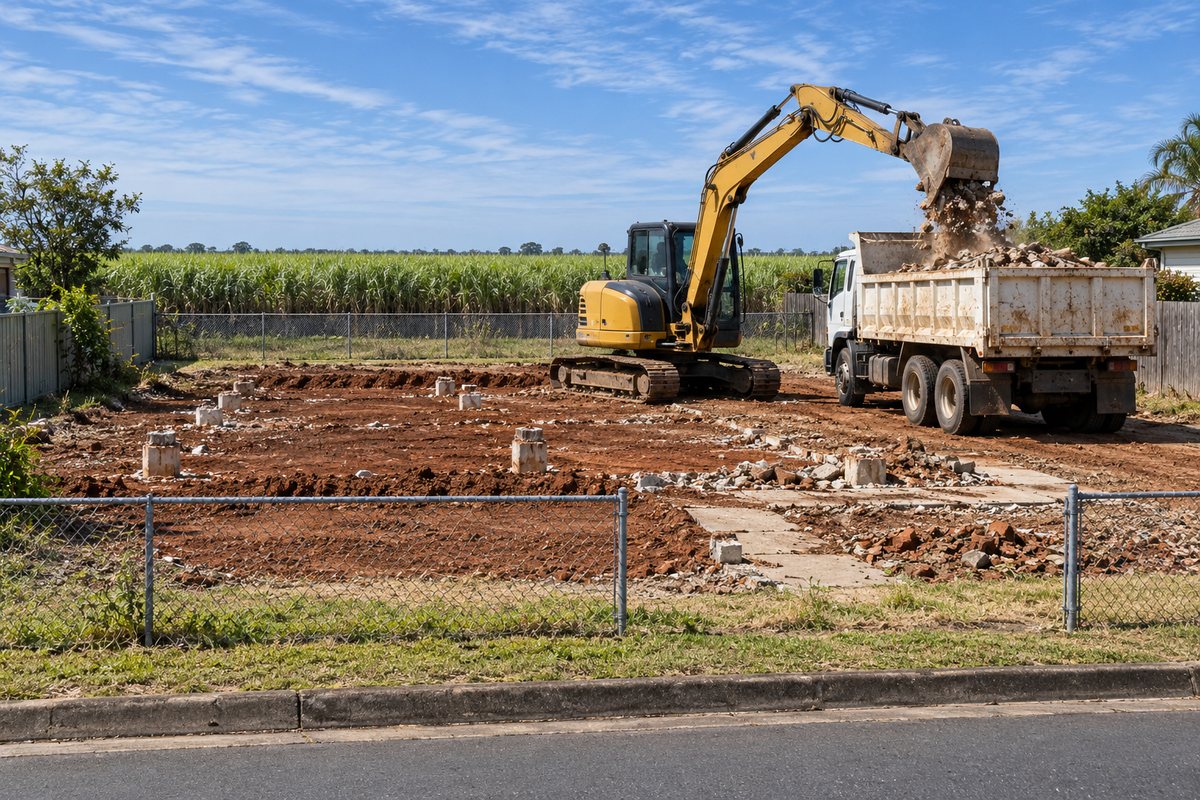
For a demolition contractor, red Woongarra loam is good ground. It drains, it holds a machine track in most weather, and it does not turn into the grey glue of the river flats after rain. Stump footings pull out cleanly. The downside is that red soil stains everything: the street, the neighbour's driveway, the tipper. A contractor keeps a hose going and sweeps the road, partly because depositing materials or a skip on the road reserve needs a Use of Road Reserve permit, $550 in 2026-27 with renewal at $183, and the contractor usually arranges it.
Where the waste goes: Qunaba first, University Drive for the rest
The closest council facility to the coast is the Qunaba Waste Facility at 132 Potters Road, Bargara, open seven days from 8.30 am to 4.30 pm. It is handy for small owner loads, but it is not a demolition tip. The council's acceptance rules limit general and construction and demolition loads at Qunaba to 3 cubic metres, and vehicles over 8 tonnes gross are not allowed in. A tipper or a tandem skip from a house demolition will not get through the gate.
So most coastal demolition waste travels to the Bundaberg Waste Facility at 46 University Drive, open Monday to Friday 7 am to 5 pm and weekends 8 am to 5 pm. That is also the only facility in the region that takes asbestos, wrapped in two layers of 200 micron plastic and labelled, at $208 a tonne with a $45 minimum from 1 July 2026; loads over 10 cubic metres need prior notice. Construction and demolition waste is $359 a tonne, clean concrete $240 a tonne, green waste $160 a tonne, and clean fill under 100 mm is free. The state levy ($135 a tonne in 2026-27) applies to landfill in the Bundaberg region; ask council how it is reflected in the gate fee. See what happens to the waste for how a contractor sorts hardwood, iron and concrete to keep the tonnage down.
Services and the practical order of a coastal job
The order on the coast is the same as anywhere in the region, with the coastal asbestos stage usually the longest part. Electricity removal is requested through the retailer; Ergon's urban removal takes up to 20 business days, with 2026-27 fees of $485.15 for the service line and $107.33 for the meter, ex GST and charged through the retailer, and the demolition must not start until Ergon confirms in writing. Water and sewer are disconnected only by council staff on the Notice to Service Provider form, and some older coastal lots still have a septic system, which has to be removed under a compliance permit rather than simply buried. Gas on the coast is usually LPG bottles, though some areas have reticulated gas through Australian Gas Networks. NBN lead-in removal is quoted case by case.
A realistic sequence for a Bargara shack: certifier's approval, services disconnected, asbestos removal with Form 65 lodged five days ahead, clearance certificate, a day or two with the excavator, then stumps, slab and septic out and the block left level. The checklist walks through the paperwork, and the permits and licences page covers who issues what. When you are ready, ask for a quote and tell us the suburb, the age of the building and what it is made of.
What this page cannot do
This page cannot tell you which overlays apply to your particular lot, what level the ground sits at relative to AHD, or whether your beach house contains asbestos. The council mapping, a survey and a laboratory sample answer those questions, not a web page. It cannot issue a building approval; only a QBCC-licensed private certifier can do that, and the certifier confirms the current conditions. It does not quote a price for demolition work, and it does not replace the written confirmation from Ergon that the power is off. Treat it as a map of what to ask about on a coastal job, then check the current rules with the certifier and the council.
Check the current rules before you rely on this
This page describes how demolition is approved, carried out and disposed of on the Bundaberg coast between Moore Park Beach and Elliott Heads. It describes the rules in general terms as they stood in October 2026. Standards, forms, thresholds and fines change.
The authoritative sources are Bundaberg Regional Council planning scheme overlays factsheet, Building Act 1975 (Queensland), Workplace Health and Safety Queensland, asbestos removal licences, Bundaberg Regional Council, waste categories and acceptance, Bundaberg Regional Council waste disposal fees 2026-27 and King 1949, Soils of the Bundaberg district, Queensland Journal of Agricultural Science. Where anything here differs from those sources, they are right and we are not.
We are not building certifiers, engineers, planners or lawyers. For what applies to your property, ask a licensed building certifier or ring Bundaberg Regional Council on 1300 883 699.
Accurate at the time of writing, October 2026. Always check the source before relying on it.