What concrete removal covers
Concrete is the part of a demolition that stays behind if nobody plans for it. A house can be gone in two days and the block still carries a cracked driveway, a shed slab, a patio and forty concrete stump pads an inch under the grass. This page is about getting all of that out, whether as the last stage of a house demolition or a job on its own because a new driveway, pool or extension is going in. The jobs we arrange across Bundaberg, Bargara, Kepnock and the rural blocks out to Gin Gin and Childers include:
- Driveways, from a single car strip to a full-width concrete apron
- House and shed slabs, including slabs with thickened edge beams
- Patios, verandah slabs, pool surrounds and outdoor laundry floors
- Garden paths, side paths and the concrete around a Hills hoist
- Strip footings and pad footings left from an earlier building
- Concrete stump pads and the cut-off stumps on a high-set block after a house is removed
- Old water tank stands, incinerator bases and septic tank lids
Thickness matters more than area. A thin path breaks under a hand-held breaker; a 100 mm driveway on mesh needs a machine; a thick shed slab with an edge beam needs an excavator with a hammer and a truck to match. We ask for the slab thickness if you know it, or a photo of a broken edge if you do not.
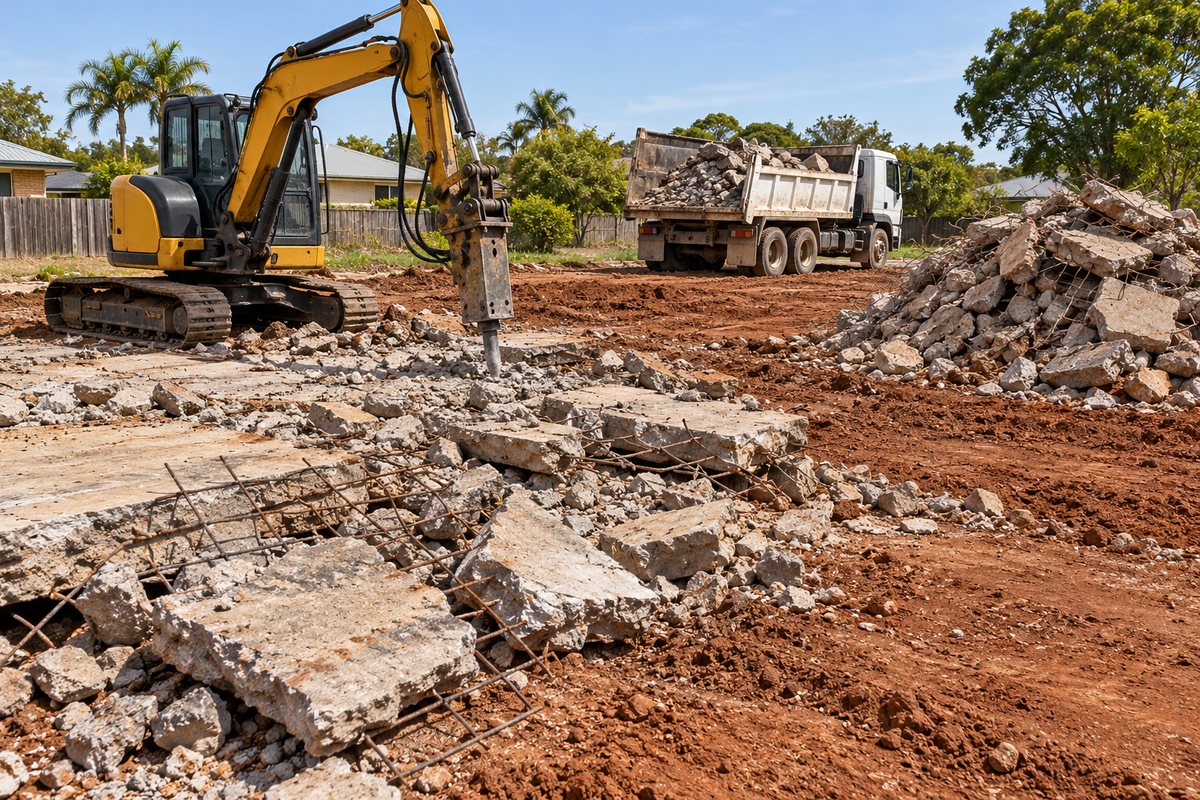
Hammer or saw: how the concrete comes out
There are two ways to take concrete out and most jobs use both. A hydraulic hammer on an excavator or skid steer is the fast way: it shatters the slab into pieces a bucket can lift, and on an open block it is the right tool for driveways, slabs and footings. The downside is vibration and noise, and the fact that a hammer does not stop neatly. If the driveway runs up against a house footing, a retaining wall or a neighbour's fence, hammering to the edge risks cracking what you want to keep.
Saw cutting handles that. A concrete saw with a diamond blade cuts a straight, clean line through the slab, so the part being removed is separated from the part staying before any breaking starts. It is used along house walls, at the boundary, at the footpath, and anywhere a tidy edge is needed for new concrete to butt against. Saw cutting is slower and wetter (the blade runs with water to control dust), so a typical driveway job is cut along the house and the footpath, then hammered between the cuts.
Reinforcing mesh changes the work. Most driveways and slabs have steel mesh in them, while some older paths have none. Mesh holds the broken pieces together, so the operator breaks the slab, then pulls and cuts the mesh free and stacks it for scrap. Mesh left tangled in the rubble turns a clean concrete load into a mixed load at the tip, the difference between $240 and $359 a tonne from 1 July 2026, so the contractor has a reason to strip it properly.
Clean concrete, mixed waste and crushing
Where the concrete ends up decides a large part of the cost. The council waste fee sheet from 1 July 2026 prices clean concrete at $240 a tonne (minimum $45), offered only at the Bundaberg Waste Facility at 46 University Drive. Mixed construction and demolition waste is $359 a tonne, and that is what you pay if the concrete arrives with soil, timber, mesh, bricks or plastic through it. Concrete is heavy: a single car driveway at 100 mm thick runs to roughly 6 to 10 tonnes depending on length and soil, so the gap between the two rates adds up on a big slab. Keeping the load clean means the operator scrapes soil off the underside, pulls the mesh and keeps the rubble on its own pile.
The alternative is not sending it to the tip at all. Clean concrete can be crushed and reused as road base, hard stand or fill, and on a larger job it is sometimes crushed on site or carted to a recycler. On rural blocks the broken concrete is often kept for a farm track or creek crossing. For a single driveway crushing is rarely worth it; for a full house slab plus driveway it is worth asking. Clean fill under 100 mm is accepted free at the Bundaberg facility (check smaller sites), so soil from under the slab goes as a separate load.
| Load from 1 July 2026 | Council rate | Notes |
|---|---|---|
| Clean concrete, no soil or mesh | $240 a tonne, min $45 | Bundaberg Waste Facility only |
| Mixed construction and demolition | $359 a tonne, min $45 | Bundaberg; Qunaba up to 3 m3, vehicles under 8 t |
| Clean fill under 100 mm | Free | Soil and spoil from under the slab |
| Coarse clean fill | $194 a tonne | Larger clean rubble and rock |
| Dirty fill | $274 a tonne | Soil mixed with rubbish |
Behind the council figures sits the Queensland waste levy, $135 a tonne on general waste in 2026-27 under the current levy rates, rising $10 a year; Bundaberg Region is inside the levy zone. That is one reason keeping concrete clean and separate is worth the operator's time. The full picture is in what happens to the waste.
Footings, stump pads and the leftovers from a house
After a house is demolished or removed, the block is rarely bare. A high-set Queenslander leaves concrete stumps or pads under timber stumps, each a lump of concrete below the surface, plus a slab under the laundry if it was built in underneath, plus strip footings if a brick skirt went round the base. Council's April 2026 removal policy requires a removal site to be cleared of debris, stumps, foundations and wastewater systems, and builders expect the same of a demolished block, so the stumps and pads are part of the job. Low-set post-war houses in Walkervale and Avenell Heights sit on a slab or on strip footings, and those have to be dug out, broken and carted before the block can be levelled.
Stump pads are dug out with the excavator bucket, knocked clean of soil and loaded with the concrete. Strip footings are broken in place and lifted. Where a new slab is going on the same spot, the builder's engineer may want the old footings out entirely, and on the Burnett grey clays of North Bundaberg and the river flats the holes are backfilled and compacted rather than left loose; on the red Woongarra loams towards Bargara the ground drains well and backfill is simpler. See demolish or remove a Queenslander for what a removal leaves behind.
Services under slabs
Concrete hides pipes. Water services run under driveways to the meter, sewer lines under side paths and laundry slabs, stormwater under patios, and power and telephone conduits under driveways to the house. A hammer through a live water main floods the job and a hammer through a sewer is worse, so the contractor locates services before breaking: checking the sewer and water plans, running a locator over the slab, and making a careful first break at the edge nearest the street. Under a house slab the services are disconnected before demolition anyway: only Bundaberg Regional Council staff disconnect water and sewer, on the Notice to Service Provider form, and electricity removal goes through your retailer to Ergon, who confirm in writing before demolition can start.
If a driveway is being replaced and the house is staying, the services stay live, which makes locating more important. The water meter is usually at the boundary and the private service from there to the house is the owner's. A gas service from the Australian Gas Networks reticulated network, where the street has one, runs underground to the meter and is located the same way. Anything found damaged is repaired before the new concrete goes in.
Driveways, crossovers and the road reserve
The driveway on your block is yours. The crossover, the section between your boundary and the kerb, and the footpath are in the council road reserve. Removing or rebuilding the crossover, cutting the footpath, or parking a truck and excavator on the verge while the driveway comes out involves the road reserve, and under the council's Local Law and the approval for works on roads process that usually needs an application and a fee. In 2026-27 a use of road reserve permit for depositing materials, construction or traffic management is $550, with renewal at $183, and a technical assessment for works in the road reserve is $222. Council engineering services are on 1300 883 699.
The simple way around this is to stop the demolition at the boundary and leave the crossover for the builder who pours the new driveway, since they will need the permit for their own work. Where the crossover has to come out now, the contractor applies for the permit and includes it in the quote. A skip bin on the road or footpath is the same permit. More under permits and licences.
Does concrete removal need a demolition licence or approval?
WHSQ's definition turns on load-bearing structure, so a freestanding path or driveway on its own is generally outside it; the contractor confirms. Where the slab is part of a building, or is removed while the building above it comes down, it is part of a demolition job and the contractor using an excavator holds the WHSQ demolition work licence. Pre-tensioned or post-tensioned slabs, found in some commercial floors rather than houses, always need the licensed contractor and a different method. We match every job to a licensed business regardless, because the same machine and operator do the slab and the house.
Building approval is a question for the certifier. Taking out a driveway on its own is usually not approvable building work, while demolishing a building, slab included, is, and the certifier confirms the position for your site. If the slab belongs to a pool, read pool demolition: the barrier cannot come down until the certifier has issued the demolition approval. Our cost guide explains the parts of a concrete quote.
What this cannot do
This service connects you with local contractors who break out and cart concrete; we do not operate machinery, pour new concrete or design footings. We cannot tell you whether a particular slab needs a building approval before it is removed, because that is the private certifier's decision, and we cannot approve work in the road reserve, which is council's. Tip rates and permit fees on this page are the council figures from 1 July 2026 and change each year, so check them before you rely on them. We do not locate underground services ourselves; the contractor does that on site and no locator finds every pipe. Weight estimates for driveways are rough and the tip's scales decide the final figure.
Check the current rules before you rely on this
This page describes how concrete slabs, paths, driveways and footings are removed in the Bundaberg region, where the concrete goes and what council permits may apply at the road reserve. It describes the rules in general terms as they stood in October 2026. Standards, forms, thresholds and fines change.
The authoritative sources are Bundaberg Regional Council waste disposal fees 2026-27, Bundaberg Regional Council, waste categories and acceptance, Waste Reduction and Recycling (Variation of Waste Levy) Amendment Regulation 2026, ABLIS, approval for works on public areas and roads, Bundaberg Regional Council and Bundaberg Regional Council Fees and Charges 2026-27. Where anything here differs from those sources, they are right and we are not.
We are not building certifiers, engineers, planners or lawyers. For what applies to your property, ask a licensed building certifier or ring Bundaberg Regional Council on 1300 883 699.
Accurate at the time of writing, October 2026. Always check the source before relying on it.