Why there is no single number
People ring asking what it costs to knock down a house in Bundaberg and the only fair first answer is a question back: what is it made of, what is in it, and how do we get a machine to it? A low-set timber and iron cottage in Walkervale on a flat corner block is one job. A block house in Kepnock with a fibro-lined laundry, a concrete pool and a single car gap to the backyard is a different one, even if the floor areas match. The demolition itself is quoted after a site visit; we do not publish a rate for it.
What we can do is lay out the parts of the price. Some are set by the contractor's labour and machine time. Others are fixed charges the contractor passes through: council tip fees, the state waste levy, Ergon's charges for taking the power off, and the certifier's fee for the building approval. Once you know which is which, a quote becomes a list you can check. The order below roughly follows how much each item tends to swing the total.
| Cost driver | What it changes | Who controls it |
|---|---|---|
| Size and construction | Machine hours, labour, tonnes to the tip | Fixed by the building; the contractor estimates it |
| Asbestos | Licensed removal, Form 65, clearance, separate disposal at $208 a tonne | WHSQ rules, the removalist's quote |
| Access and machine size | Which excavator fits, how many loads, hand work | The block, the neighbours, the street |
| Salvage | Credit for hardwood, iron and bricks that have a buyer | Market demand and the contractor's effort |
| Tip fees and levy | C&D $359 a tonne, clean concrete $240, green waste $160 (from 1 July 2026) | Council; the $135 state levy applies to landfill in the region |
| Services abolishment | Ergon $485.15 plus $107.33 ex GST via your retailer; water and sewer by council | Ergon, AGN or LPG supplier, council |
| Building approval | Certifier's fee for the demolition approval | The private certifier |
| Council fees | $1,770 if a local heritage place is involved; $550 road reserve permit | Bundaberg Regional Council, 2026-27 |
Size and what the house is built from
Floor area matters less than people expect. What matters is weight and how the building comes apart. A timber framed house with an iron roof and a fibro or weatherboard skin is light, pulls apart in a predictable order, and much of it leaves the block as salvage or timber waste rather than rubble. The same floor area in brick veneer adds tonnes of masonry that go straight to the tip at the construction and demolition rate. A block or double brick house adds more again, and a house on a slab means the slab is broken out and carted, usually as a separate line in the quote.
Across the older suburbs the stock broadly runs from high-set timber Queenslanders in Bundaberg East and Bundaberg South, through the post-war fibro and timber homes of Walkervale, to the brick and block houses of Avenell Heights from the late 1960s onward. Most quotes are for a house plus whatever sits around it: a shed, a carport, paths, a tank stand. They add up, so walk the whole block with the contractor. On a high-set house, a built-in ground floor comes down first and the stumps and footings are dealt with separately; a contractor will usually leave the block clear of stumps, foundations and wastewater systems.
Asbestos is the biggest single variable
WHSQ presumes asbestos in any building built before 31 December 1989 until a sample shows otherwise. The usual places in Bundaberg's older stock are fibro cladding, eave sheets, wet area linings, backing under floor tiles, the old meter board. Asbestos changes the price in three ways. First, it comes out before the machine starts, by hand, wet, by a licensed removalist where the area is more than 10 square metres of bonded sheet (Class B) or any friable material (Class A). Second, that work needs a Form 65 notification to WHSQ at least five days before it starts, a removal control plan and a clearance afterwards, all of which are time. Third, the waste cannot go to the tip with the rest of the house. It is double wrapped in 200 micron plastic, labelled, tracked, and taken only to the Bundaberg Waste Facility at 46 University Drive, where council charges $208 a tonne from 1 July 2026 with a $45 minimum. Loads over 10 cubic metres need prior notice.
Under 10 square metres, say one laundry wall, no licensed removalist is needed but the Code of Practice still applies and the sheets still go to University Drive as asbestos waste. On a fully fibro-clad house the asbestos component can rival the demolition component. The rules are on our asbestos rules page and the service on asbestos removal before demolition.
Access and the size of the machine
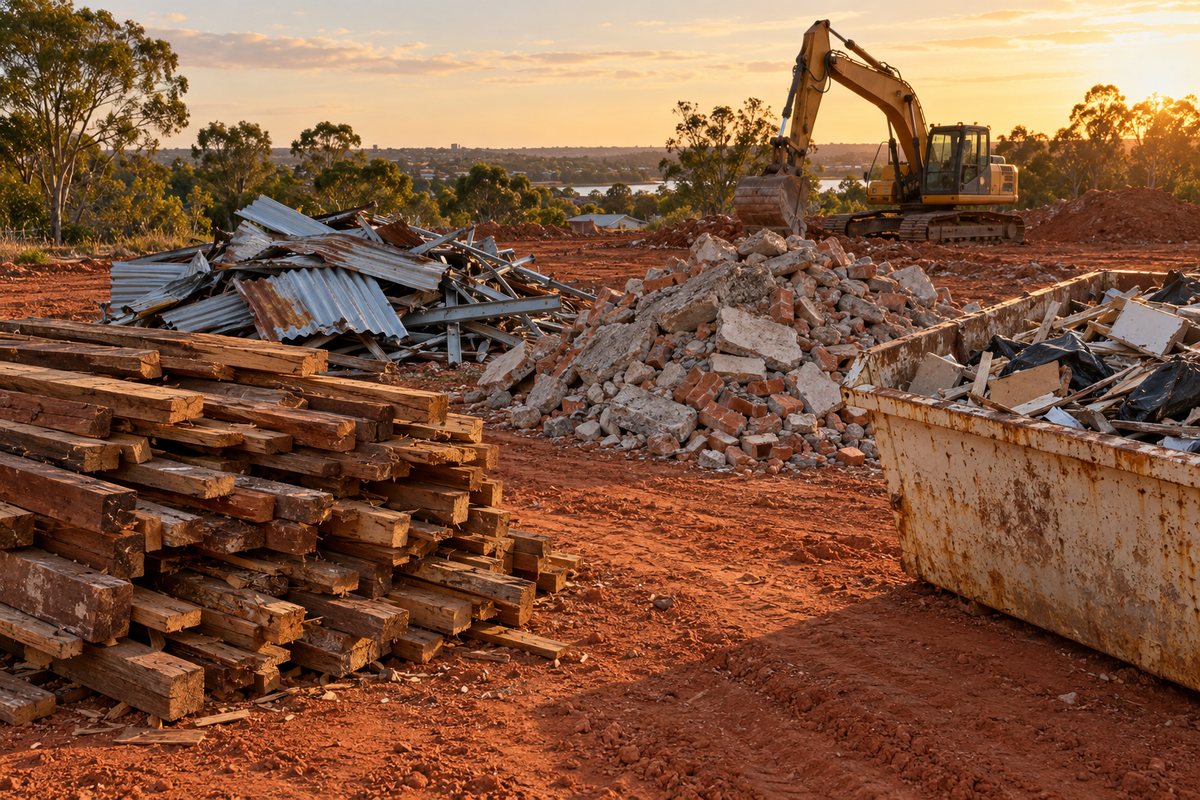
The cheapest demolition is one where a 13 to 20 tonne excavator can drive in beside the house and the tippers back up to it, which on a wide block in Avoca is normal. On a narrow inner Bundaberg lot with the house close to both boundaries and power lines across the front, the contractor may be limited to a compact machine, which means more hours, or to taking the first stages down by hand. Ground plays a part too: the red Woongarra loams around Bargara carry a machine in most weather; the grey Burnett clays on the North Bundaberg flats bog after rain. If a skip has to sit on the street, a council road reserve use permit comes into it at $550 for 2026-27 (renewal $183), and traffic management on a busy road is a cost on top.
Salvage can offset part of the bill
Old Bundaberg houses are full of material that still has a buyer: seasoned hardwood bearers, joists and floorboards, verandah boards, casement windows, VJ lining, corrugated iron, old pressed bricks. A contractor who strips these out before the machine goes in spends more labour but carts fewer tonnes and may credit some of the salvage against the quote. Ask how salvage is treated, and name any items you want in writing before the job starts; once the excavator is working nothing comes out intact. Salvage only works on buildings worth stripping: termite damage, rot or asbestos cladding over the timber all cut the value, as demolish or remove a Queenslander explains.
Tip fees and the state levy
Everything not salvaged or reused on site goes to a council facility and is weighed. From 1 July 2026 the Bundaberg Regional Council fee sheet charges $359 a tonne for construction and demolition waste with a $45 minimum, $240 a tonne for clean concrete (Bundaberg facility only), and $160 a tonne for green waste. Clean fill under 100 mm is free. The state levy ($135 a tonne in 2026-27, rising $10 a year) applies to landfill in the Bundaberg region; ask council how it is reflected in the gate fee.
The gap between $359 for mixed rubble and $240 for clean concrete, or $160 for green waste, is why sorting on site pays. Concrete with mesh in it is not clean concrete. A contractor who tips everything as mixed C&D pays the top rate for every tonne, and that is in your quote whether or not it is itemised. Facilities and load limits are on where the waste goes.
Services, the certifier and council
Before the machine arrives the house has to be dead. Electricity abolishment goes through your retailer to Ergon, which for an urban removal works within 20 business days and charges, for 2026-27, $485.15 for service line removal and $107.33 for meter removal, ex GST via the retailer. The contractor cannot start until Ergon confirms the removal in writing. Natural gas (Australian Gas Networks) and LPG have their own disconnection steps. Water and sewer are disconnected only by council staff, on the Notice to Service Provider form, fee payable before approval. NBN lead-in removal is quoted case by case. Small items, but they take weeks and belong in the budget; the sequence is on our pre-demolition checklist.
Demolishing a building is building work under the Building Act 1975, so it needs a building approval from a QBCC-licensed private certifier (council has not certified since September 2015). The certifier sets their own fee and confirms the current conditions; under s 71 the work usually has to substantially start within two months and finish within a year. Council fees only come in where the planning scheme does: building works involving demolition of a local heritage place cost $1,770 for 2026-27, and use of the road reserve needs the $550 permit. Overlay-only code assessment carries no council fee. See permits and licences and heritage and character demolition.
Seven things a quote should spell out
A demolition quote in Bundaberg is only comparable with another if both say the same things. Check that it covers these seven points in writing.
- Scope. Which structures come down: house, sheds, carport, pool, paths, slabs, fences, tanks, trees. Anything not named is not included.
- Asbestos. Whether a survey is done or included, who the licensed removalist is, that a Form 65 and clearance certificate are part of the job, and whether disposal is priced or provisional.
- Licence numbers. The contractor's WHSQ demolition work licence and, where it applies, the asbestos removal licence class. Demolition in Queensland is licensed by WHSQ, not QBCC.
- Tip fees and levy. Whether disposal is a fixed sum or charged on tip dockets, and what the allowance assumes.
- Salvage. Who owns the hardwood, iron and bricks, and whether a credit applies.
- Services. Who organises Ergon, gas, water, sewer and NBN, and whether the Ergon fees are in the price or paid through your retailer.
- Finish. Stumps and footings out, slab out or left, wastewater system removed, site levelled, and whether any fill is imported.
If a quote is silent on any of these, ask. Then send through the address and a few photos and we will arrange a site visit.
What this page cannot do
This page cannot price your demolition. The only way to get a figure is a site visit from a licensed contractor who looks at the construction, the asbestos, the access and the waste streams, and the final cost depends on what the tip dockets say. The council, Ergon and levy figures here are the published 2026-27 rates and they change every July; confirm the current numbers with council on 1300 883 699 and with your electricity retailer. The certifier's fee is set by the certifier. Nothing here is a quote, a promise of a fee, or advice on whether your particular building needs a development application; the certifier and council decide that.
Check the current rules before you rely on this
This page describes the factors that determine the cost of demolition in the Bundaberg region and the published council, Ergon and levy charges that sit inside a quote. It describes the rules in general terms as they stood in October 2026. Standards, forms, thresholds and fines change.
The authoritative sources are Bundaberg Regional Council waste disposal fees 2026-27, Waste Reduction and Recycling (Variation of Waste Levy) Amendment Regulation 2026, Waste levy zone, Schedule 2 of the 2022 amendment regulation, Ergon Energy, removal of an electricity connection, Bundaberg Regional Council Fees and Charges 2026-27 and Workplace Health and Safety Queensland, asbestos notifications. Where anything here differs from those sources, they are right and we are not.
We are not building certifiers, engineers, planners or lawyers. For what applies to your property, ask a licensed building certifier or ring Bundaberg Regional Council on 1300 883 699.
Accurate at the time of writing, October 2026. Always check the source before relying on it.