Presume asbestos in anything built before 1990
Queensland's starting rule is simple. Workplace Health and Safety Queensland (WHSQ) says a building constructed before 31 December 1989 is presumed to contain asbestos unless an inspection shows otherwise. The rule appears on the WHSQ demolition notifications page in the context of emergency demolition, but contractors apply it to every job because it reflects what they find. In Bundaberg the presumption reaches a large share of the housing stock: the post-war fibro cottages of Walkervale and Avenell Heights, the 1960s and 1970s brick houses with fibro eaves and wet areas, and the sheds and fences behind the older Queenslanders. Even a 1920s timber house often has an asbestos cement bathroom or a later fibro enclosure underneath.
So the first step on a pre-1990 demolition is an inspection by a competent person, usually an occupational hygienist or licensed assessor, who samples suspect materials and writes a register. The register tells the contractor what has to come out, by whom and under what licence, before the excavator goes near the building. Our asbestos removal service page describes that sequence; this page sets out the rules behind it.
Class A, Class B and the 10 square metre line
Asbestos removal is licensed by WHSQ under the Work Health and Safety Regulation 2011, separately from the demolition work licence. There are two classes, explained on the WHSQ asbestos licence page. A Class A licence is needed to remove any amount of friable asbestos, material that can be crumbled by hand such as pipe lagging, sprayed insulation or badly weathered sheeting. A Class B licence is needed to remove more than 10 square metres of non-friable (bonded) asbestos, the ordinary asbestos cement sheeting, corrugated roofing and vinyl floor tiles found in houses. WHSQ's licence page sets out what each class covers.
Below 10 square metres of non-friable material no licence is required, and that is where a lot of poor practice hides. The exemption does not mean the rules disappear: the WHS Regulation still applies, and so does the How to Safely Remove Asbestos Code of Practice 2021, which covers wetting down, protective equipment, decontamination and packaging for small jobs, and a safe work method statement is still required. On a demolition the exemption is close to irrelevant, because a single fibro wall exceeds it, so any house with asbestos cement needs a Class B removalist before demolition and a Class A removalist if anything friable is found.
Licence fees are set by WHSQ. The last figure we can cite is from the 2024-25 WHSQ licence fees page: $209.56 for a Class A or Class B removal licence or an assessor licence. We flag that as the last published figure rather than the current one; it is a cost to the contractor, and the current amount is on the WHSQ page.
| Material and quantity | Licence needed | Control plan | Clearance certificate | WHSQ notification |
|---|---|---|---|---|
| Friable, any amount | Class A | Yes | Yes, by an independent licensed asbestos assessor | Form 65, 5 days before |
| Non-friable, more than 10 m2 | Class B (or A) | Yes | Yes, by an independent competent person not involved in the removal | Form 65, 5 days before |
| Non-friable, 10 m2 or less | None, but Code of Practice and WHS Regulation apply | No, but SWMS still required | Not required | Not required |
| Emergency removal | As above | As above | As above | Ring 1300 362 128 first, Form 65 within a day |
Form 65 notice and the removal control plan
Licensed asbestos removal must be notified to WHSQ at least 5 days before it starts, on Form 65 lodged online. The WHSQ asbestos notifications page explains the process. The removalist lodges it, not the owner, but the 5 days is a hard lead time and the most common reason a start date slips by a week. Emergencies are handled by ringing WHSQ on 1300 362 128 and lodging Form 65 within a day, but a planned demolition is not an emergency. The same form covers notifiable demolition work (a load-bearing structure 6 metres or more high, machinery on a suspended floor, explosives), so a two-storey block of flats with asbestos generates two notifications; the permits and licences page covers that side.
For all licensed removal, Class A or Class B, the removalist must prepare an asbestos removal control plan before work starts and keep it on site. The Queensland asbestos site's control plan page describes its contents: what is being removed and where, the method, controls such as wetting and enclosure, equipment and PPE, decontamination, and how waste will be packaged and moved. It is not required under 10 square metres of non-friable material, though a safe work method statement is. Ask to see it; a removalist who cannot produce one on the morning of the job has not met the Regulation.
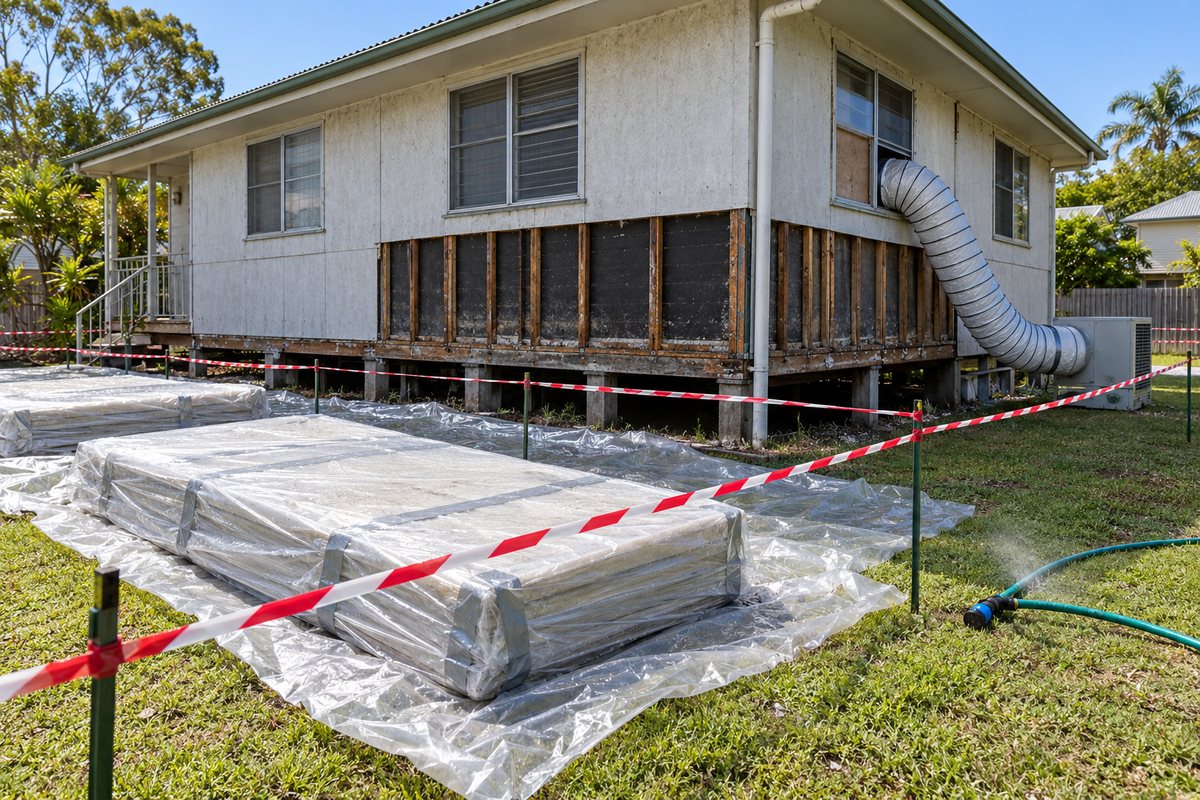
For Class A work the plan will usually describe a sealed enclosure with negative-pressure air units and exhaust ducting, and the assessor decides whether air monitoring is part of the clearance. Any result above 0.02 fibres per millilitre must be reported to WHSQ immediately. That figure, from the WHSQ notifications page, is a control level, not a safe level; the goal on every job is as close to zero as the method allows.
Clearance inspections and who can sign them
After licensed removal, and before the area is reoccupied or demolition machinery moves in, a clearance inspection is required and a written certificate issued. Who does it depends on the class, as set out on the Queensland asbestos clearance page. For Class A friable removal it must be an independent licensed asbestos assessor, who decides whether air monitoring is part of the clearance. For Class B removal it must be an independent competent person not involved in the removal, holding one of the recognised units of competency (CPCCDE5001, CPCCDE3014 or CPCCDE3015). Independence is the point: the person signing off cannot be the crew that did the work. No certificate is required for 10 square metres or less of non-friable material, and on domestic premises the removalist is responsible for arranging the inspection.
On a demolition the clearance certificate is the document that releases the excavator. A competent contractor will not start mechanical demolition of a pre-1990 house until the asbestos is out under licence and the clearance is in hand, because once a machine has crushed sheeting into the rubble the whole load has to be handled as asbestos waste. Keep the certificate with the demolition approval.
Wrapping, transport and disposal at University Drive
Packaging rules are the same regardless of quantity. Material is wetted down, wrapped in two layers of 200 micron plastic, taped and labelled CAUTION ASBESTOS, and never goes into a wheelie bin or general skip. Those requirements are summarised in a Livingstone Shire Council commercial fact sheet that reflects the statewide rules. Whole sheets are stacked flat on plastic and wrapped as a pallet; broken pieces go into lined bins or bags.
Transport is regulated by the environment department rather than WHSQ. The transport requirements page says a person needs an environmental authority (ERA 57) to transport more than 175 kilograms of asbestos waste, and commercial transport needs waste tracking regardless of quantity; non-commercial transport over 250 kilograms also needs tracking. So any contractor carrying asbestos from your block is working under an environmental authority and lodging tracking documents, and you can ask for the tracking number as proof of where the load went. Disposal is only lawful at a licensed landfill.
In the Bundaberg region the only council facility that accepts asbestos is the Bundaberg Waste Facility at 46 University Drive; Qunaba, Tirroan, Childers and the rural stations do not take it. Council's waste categories and acceptance page sets the conditions: non-friable material must be wrapped, generated within the region and tracked, and loads over 10 cubic metres need prior notification. Friable asbestos is accepted only between 8.30 am and 3.30 pm, wet down, for special burial. The gate hours are 7 am to 5 pm on weekdays and 8 am to 5 pm on weekends, so the friable window is narrower and a contractor needs to time the trip.
The disposal fee from 1 July 2026 is $208 a tonne for asbestos and asbestos-containing material, with a $45 minimum, per council's 2026-27 waste disposal fees. The same schedule charges $208 per 3 hours plus tonnage for special burial, which is how friable loads are handled. A fibro house in Walkervale yields a few tonnes of asbestos cement, so the disposal line on a quote is real but not the biggest item; the hand labour under licence is. The waste guide covers the rest of the stream, including the $359 a tonne construction and demolition rate. The Queensland waste levy sits behind these fees: Bundaberg Region is in the levy zone and the 2026-27 levy is $135 a tonne for general waste, rising $10 a year, per the levy rates regulation and the levy zone schedule. How the levy is reflected in the asbestos rate is a question for council; budget on the $208 at the gate.
What the owner is responsible for
The licensed removalist carries the WHS duties, but the owner is not a bystander. You choose the contractor, and you can check the WHSQ licence and its class. You should receive and keep the asbestos register, the Form 65 notification, the control plan, the clearance certificate and the waste tracking record; a buyer's solicitor or a bank may ask for them later. Neighbours have a right to know that licensed removal is happening, and tape and signage at the boundary are part of the method.
Do not try to save money by stripping fibro yourself before the contractor arrives. Beyond the health risk, you would be removing more than 10 square metres without a licence, and unwrapped asbestos cement in a trailer load at University Drive is refused at the gate. A contractor who finds a part-stripped house will usually treat the whole site as contaminated and the cost goes up. The cost guide explains how asbestos content moves the price on a typical Bundaberg job.
What this page cannot do
This page cannot tell you whether your house contains asbestos or how much; only an inspection with sampling by a competent person can do that. It cannot confirm that any particular removalist holds a current Class A or Class B licence, because licences expire and WHSQ's records are the only authority. It does not reproduce the Work Health and Safety Regulation 2011 or the Code of Practice, and the Regulation's section numbers are not quoted for that reason. The council fees, levy rates and facility hours are those published for 2026-27 and will change. Nothing here is occupational hygiene, legal or medical advice.
Check the current rules before you rely on this
This page describes the asbestos licensing, notification, clearance, transport and disposal rules that apply to demolition in the Bundaberg region. It describes the rules in general terms as they stood in October 2026. Standards, forms, thresholds and fines change.
The authoritative sources are Workplace Health and Safety Queensland, asbestos removal licences, Workplace Health and Safety Queensland, asbestos notifications, asbestos.qld.gov.au, asbestos removal control plans, asbestos.qld.gov.au, clearance inspections and certificates, asbestos.qld.gov.au, transporting and disposing of asbestos waste and Bundaberg Regional Council, waste categories and acceptance. Where anything here differs from those sources, they are right and we are not.
We are not building certifiers, engineers, planners or lawyers. For what applies to your property, ask a licensed building certifier or ring Bundaberg Regional Council on 1300 883 699.
Accurate at the time of writing, October 2026. Always check the source before relying on it.