What rural demolition looks like out here
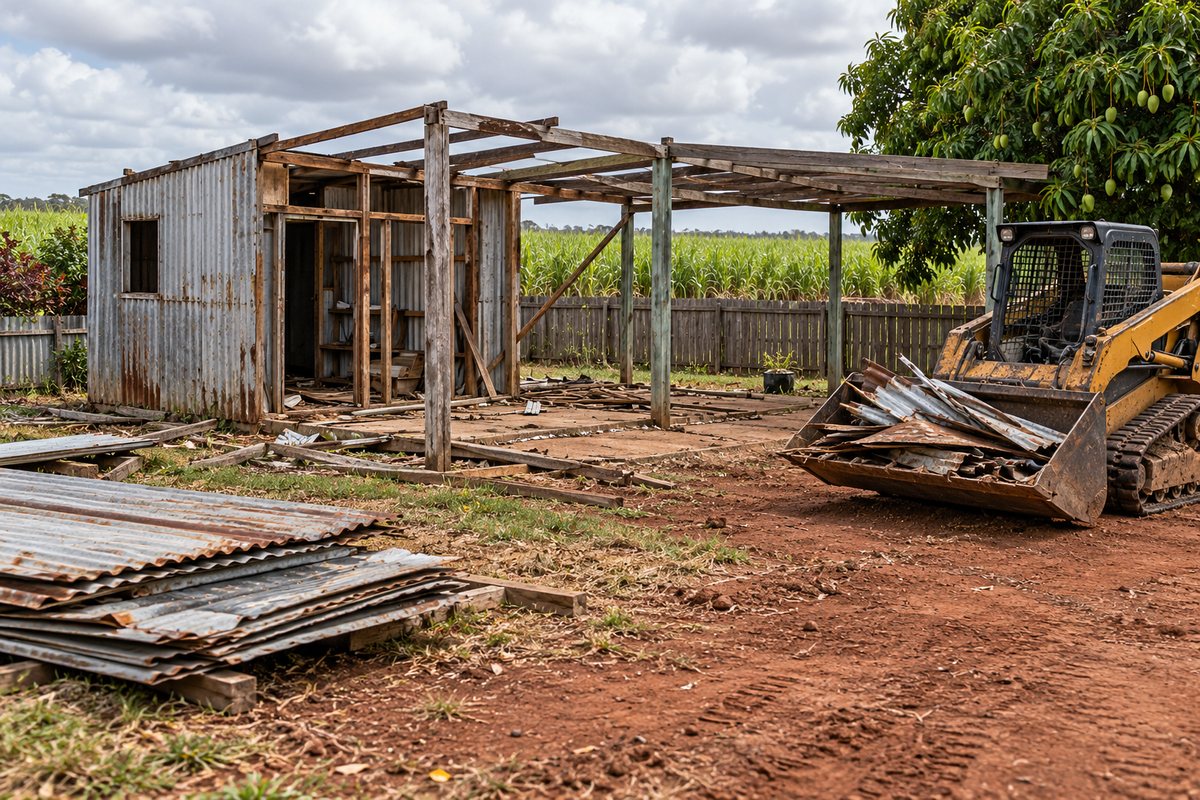
Drive south-west to Childers or north-west to Gin Gin and the demolition work changes character. In town it is houses on quarter-acre blocks. Out here it is the farm infrastructure of a century of cane, small crops and grazing: iron machinery sheds on timber or steel posts, old timber farmhouses that the family moved out of when the new brick one went up, cane cutters' barracks that have been storing fertiliser since the 1960s, packing sheds from the small-crop era, dairy bails, silos, and the odd corrugated iron church hall. Most of it is lightweight, most of it is old enough to be presumed to contain asbestos, and almost all of it is a long way from the tip.
The job is often less about the building and more about logistics: can a float get a 20-tonne excavator down the farm track, is there a creek crossing, where does the waste go, and is there power to the building that nobody has thought about for 30 years. Our shed and garage page covers the building types in detail; this page is about the district.
Travel, access and getting machinery to the job
Gin Gin and Childers are each roughly 50 kilometres from Bundaberg, about 45 minutes each way, Woodgate further again on the coast, and the farming blocks around Bullyard, Wallaville, Booyal, Cordalba and Apple Tree Creek are spread across a lot of country. A demolition contractor based in Bundaberg has to move a machine and a tipper each way on every working day, or leave them on site. For a one-day shed job that travel can be a large share of the cost. The cost guide explains the other drivers.
Access is the other half. A farm track that carries a ute may not carry a float with an excavator on it, cattle grids have weight limits, and an iron shed on the far side of a cane paddock may only be reachable after harvest. Contractors ask for photos of the track and any crossings before they quote, and often prefer a skid steer or compact excavator that travels on a smaller truck.
The licensing does not change with the postcode. Any demolition done with an excavator, loader or skid steer needs the contractor to hold the Workplace Health and Safety Queensland demolition work licence under the WHS Regulation 2011, even for a farm shed; the exemption for a domestic house and its carport or garage applies only when no load-shifting machinery is used. The WHSQ licence page explains this and lists licensed contractors.
Where rural demolition waste goes
The council runs small waste facilities at Tirroan, on Tablelands Road at Dalysford via Gin Gin, and at Childers on Nissens Lane, along with transfer stations at Avondale, South Kolan, Booyal, Buxton and Woodgate. They are useful for a farm clean-up, but they are not demolition tips. The council's acceptance categories allow general waste up to 3 cubic metres at Tirroan and Childers, and construction and demolition waste only in loads under half a cubic metre. None of them accept asbestos.
So the realistic position is that nearly all demolition waste from Gin Gin, Childers and the farming districts is carted to the Bundaberg Waste Facility at 46 University Drive, open Monday to Friday 7 am to 5 pm and 8 am to 5 pm on weekends. That is the only council facility in the region that takes asbestos, wrapped in two layers of 200 micron plastic and labelled, at $208 a tonne with a $45 minimum from 1 July 2026; loads over 10 cubic metres need prior notice, and a commercial carrier needs waste tracking for asbestos regardless of the amount. Construction and demolition waste is $359 a tonne, clean concrete $240, green waste $160. The state levy ($135 a tonne in 2026-27) applies to landfill in the Bundaberg region; ask council how it is reflected in the gate fee.
| Facility | Where | Hours | What it takes from a demolition |
|---|---|---|---|
| Tirroan | 72 Tablelands Road, Dalysford via Gin Gin | Mon to Sat 7.30 am to 12 pm, Sun 11 am to 2 pm | General up to 3 m3; demolition waste under 0.5 m3 only; no asbestos |
| Childers | 17 Nissens Lane | Mon to Fri 7.30 am to 12.30 pm, Sat and Sun 9 am to 12.30 pm | General up to 3 m3; demolition waste under 0.5 m3 only; no asbestos |
| Bundaberg Waste Facility | 46 University Drive | Mon to Fri 7 am to 5 pm, Sat and Sun 8 am to 5 pm | All demolition loads; the only facility accepting asbestos |
Childers: a heritage town centre in the character overlay
Childers is the one place in the rural districts where the planning scheme's Heritage and neighbourhood character overlay matters as much as it does in inner Bundaberg. The council's heritage properties page names the Childers town centre, with the Bundaberg town centre and the older timber-and-tin suburbs, as a neighbourhood character area. Inside a mapped character area a development application is required before demolishing, relocating or removing a Victorian, Federation or Interwar building, and the Childers main street is full of them: the verandahed shops, the hotels, the old banks and the houses behind them. Demolition of one of the region's 79 local heritage places is generally not supported by the council and carries a $1,770 fee in 2026-27.
There is no pre-1946 year test here, which is a Brisbane rule only. What triggers the application is the building's era and the mapping, so a 1960s fibro house in a Childers back street is usually outside it while a 1910 shopfront on the main street is inside. Code assessment triggered only by the overlay has no council fee. Outside the town centre, in Apple Tree Creek, Cordalba, Horton and the farm country, character mapping is rare and most old farmhouses can be demolished with a building approval from a private certifier alone. The heritage and character page goes through the application process, and a call to the duty planner on 1300 883 699 settles the mapping question for a given lot before anyone pays a certifier.
Bushfire, biodiversity and vegetation on rural blocks
Two more of the twelve overlays come into play on rural land far more than in town. The Bushfire hazard overlay can apply to forested and grassland country in the rural districts; check the mapping. It affects the rebuild rather than the demolition: a new shed or house in a bushfire area is assessed against it. The Biodiversity areas overlay is the one that can affect the demolition itself. Where it applies, the planning scheme's vegetation management code governs clearing, and the council says a permit may be required to clear protected plants or remnant vegetation under the Nature Conservation Act 1992 and the Vegetation Management Act 1999. Taking down a shed does not need a vegetation permit; pushing out the scrub around it to get a machine in, or clearing a fence line for the float, might. Clearing for an urban purpose on freehold land in an urban area is exempt under the Planning Regulation 2017, but Gin Gin farm country is not an urban area. In practice, the contractor stays on the existing cleared footprint and the owner asks the council before clearing anything mapped.
Woodgate is its own case: a coastal village with beach shack stock, the Coastal protection and acid sulfate soils overlays on the foreshore, and bushfire and biodiversity mapping in the bush behind it. A shack demolition there can have all of those overlays on the lot, even if the demolition itself only needs the certifier's approval.
Lake Monduran and the Kolan catchment
North and west of Gin Gin the Kolan River runs down from Lake Monduran, and the planning scheme's Water resource catchments overlay covers the catchments of the Burnett and Kolan barrages and the lake. The overlay exists to protect drinking water, and a demolition within the overlay has to be careful about three things that a suburban job can take for granted: fuel and hydraulic oil from the machine, asbestos fibre and dust in runoff, and the old septic or long-drop system on the farmhouse. A demolition contractor working near Monduran or on a Kolan bank keeps the asbestos stage wet and wrapped, keeps the spoil out of the drainage line, and does not bury the old wastewater system. Council's April 2026 removal policy requires a removal site to be cleared of wastewater systems along with debris, stumps and foundations, builders expect the same of a demolished block, and disconnecting and removing an on-site sewerage facility needs a council compliance permit at $650 in 2026-27.
Services on rural blocks are simpler and harder at the same time. Most farmhouses are on LPG bottles rather than the Australian Gas Networks reticulated supply in town, on tank water or a bore rather than council water, and on a septic rather than council sewer, so there may be no council disconnection to arrange at all. Electricity is the exception. An old shed or barracks often has a live line to it that nobody has used in decades, and the connection still has to be abolished through the retailer; Ergon's 2026-27 fees are $485.15 for the service line and $107.33 for the meter, ex GST, and demolition must not start until Ergon confirms in writing. Ergon's 20 business day standard is for urban removals; ask about rural lead times. The permits and licences page covers the certifier, the WHSQ notices and the council forms, and the quote form asks about the track and the crossings first.
What this page cannot do
This page cannot tell you whether a particular building in Childers is inside the character area or is a local heritage place; the council's mapping and the duty planner do that. It cannot tell you whether the scrub around a shed is protected vegetation or whether your block is in the biodiversity, bushfire or catchment overlays. It does not issue building approvals, which come from a QBCC-licensed private certifier who confirms the current conditions, and it does not quote demolition work or travel. It cannot judge whether a farm track will carry a float. Use it to understand what is different about a rural job, then check your own lot with the council and a licensed contractor.
Check the current rules before you rely on this
This page describes demolition of sheds, farmhouses and other buildings in Gin Gin, Childers, Woodgate and the rural districts of the Bundaberg region. It describes the rules in general terms as they stood in October 2026. Standards, forms, thresholds and fines change.
The authoritative sources are Workplace Health and Safety Queensland, demolition work licence, Bundaberg Regional Council, heritage properties and neighbourhood character, Bundaberg Regional Council waste facilities and opening hours, Bundaberg Regional Council, waste categories and acceptance, Bundaberg Regional Council, native plants and vegetation clearing and Bundaberg Regional Council planning scheme overlays factsheet. Where anything here differs from those sources, they are right and we are not.
We are not building certifiers, engineers, planners or lawyers. For what applies to your property, ask a licensed building certifier or ring Bundaberg Regional Council on 1300 883 699.
Accurate at the time of writing, October 2026. Always check the source before relying on it.