Why most older Bundaberg houses are assumed to contain it
Workplace Health and Safety Queensland's rule is simple: a building constructed before 31 December 1989 is presumed to contain asbestos unless a survey shows it does not. In a region where 85 per cent of dwellings are separate houses and much of the housing broadly went up between the 1920s and the 1970s, that rule catches a large share of the housing stock. Bundaberg East has been built on since 1882, Bundaberg South since the 1870s, Walkervale filled in after the war with its school opening in 1955, and Avenell Heights was only named in 1967. Fibre cement sheet was a cheap cladding and lining across much of that period, and it was used in Queenslanders as well as in the fibro houses people usually think of.
The presumption is not a formality. It decides who is allowed to touch the house and in what order. A demolition contractor cannot send a machine into a presumed-asbestos house, because crushing bonded sheet turns a low-risk material into airborne fibre across the site and into the neighbours' yards. The survey and the removal come first, and the clearance certificate is the document that lets the demolition stage begin. That is why this is a separate service with its own licence, its own notice to WHSQ and its own disposal rules, even when the same business does both halves of the job.
Where it hides in a Queenslander and a fibro house
In a post-war fibro house the sheet is the house: external wall cladding, often with a cover strip at every joint, eaves and soffit linings, and internal wall and ceiling linings in the wet areas and sometimes throughout. Behind the kitchen and bathroom tiles there is often a compressed sheet, and the bathroom floor may sit on one too. Vinyl floor tiles and the black adhesive under them, the backing to old sheet vinyl, the flue on a gas heater, the lagging on a hot water pipe and the insulating board behind the stove can all contain it. Corrugated fibre cement roofing and fencing were common. A 1960s house in Walkervale or Avoca can easily hold well over a hundred square metres across all of those elements.
In a timber Queenslander it is less obvious because the outside is weatherboard and the inside is usually VJ boards. Look under the house: the batten-and-sheet enclosures added to make a laundry, a bathroom or a flat downstairs are very often fibre cement, as are the later sleep-outs and verandah enclosures that nearly every one of these houses has acquired. Kitchens and bathrooms that were updated in the 1950s to 1980s were lined with it. Eaves linings were often replaced with it when the original timber rotted. Electrical boards and meter box backing panels were made of it. The house itself might be 1910; the material in it might be 1965.
The survey finds all of this. A competent person inspects every accessible part of the building, takes samples and sends them to a laboratory, and writes a register listing each item, its location, its condition and whether it is friable or bonded. The register is what the licensed removalist prices and works from, and it is what the demolition contractor relies on to know that what is left is safe to crush. Our asbestos rules page goes through the regulation behind each step.
Class A, Class B and the 10 square metre rule
Queensland has two removal licence classes. Class B covers bonded, non-friable material such as sheet and corrugated roofing, and is required whenever more than 10 square metres is removed. Class A covers any friable material at all, in any quantity; WHSQ's licence page sets out what each class covers. Friable material is anything that can be crumbled by hand pressure when dry: pipe lagging, sprayed insulation, the loose fill sometimes found in older ceilings, and badly weathered or fire-damaged sheet that has lost its cement binder. Friable removal needs full enclosure, negative air and decontamination, and it is slower and costs more. The licence classes are set out on the WHSQ asbestos licence page.
Below 10 square metres of bonded material no licence is required. That does not mean the rules switch off. The WHS Regulation and the How to Safely Remove Asbestos Code of Practice still apply, a safe work method statement is still needed, the same wetting, wrapping and labelling applies and the waste still goes only to a licensed facility. Ten square metres is roughly one small bathroom's wall lining, so in practice the exemption matters for a single eave panel or a small fence, not for a house.
| Situation | Licence | Notice and paperwork |
|---|---|---|
| Bonded sheet, 10 m2 or less | None | SWMS, Code of Practice, wrap and label, licensed disposal |
| Bonded sheet, more than 10 m2 | Class B | Form 65 five days ahead, removal control plan, clearance by independent competent person |
| Any friable material | Class A | Form 65 five days ahead, removal control plan, enclosure, clearance by licensed assessor |
| Demolition of structure 6 m or more high | Demolition licence if machinery is used or the structure is not a domestic house or outbuilding | Separate Form 65 demolition notice five days ahead |
Form 65, the control plan and the clearance certificate
Licensed removal must be notified to WHSQ at least five days before it starts. The notice is lodged online on Form 65, and the same form is used for the separate demolition notification that applies when a load-bearing structure six metres or more high is coming down. The five days are not working days you can trade away; a removalist who starts early is working unlawfully and the clearance that follows may not be worth anything. Emergency removal can be phoned through and the form lodged within 24 hours, but a planned demolition is never an emergency. The notification rules are on the WHSQ asbestos notifications page.
Before any licensed removal the removalist prepares an asbestos removal control plan, as described on the Queensland asbestos control plan page. It sets out what is being removed, how, with what controls, how the waste is handled and who is on site. It is kept on site for the duration. Under 10 square metres a control plan is not required but a safe work method statement still is.
When the removal is finished an independent person inspects the area and issues a written clearance certificate. For Class B work that is a competent person who was not involved in the removal and who holds the relevant units of competency; for Class A work it must be a licensed asbestos assessor, and the assessor decides whether air monitoring is part of the clearance. For a domestic job the removalist is responsible for arranging the clearance. No certificate is required for work under 10 square metres. The clearance is the piece of paper the demolition contractor needs before the excavator starts, and it is the one to keep with the property file afterwards. The clearance rules are on the Queensland asbestos clearance page.
Wrapping, transport and disposal at University Drive
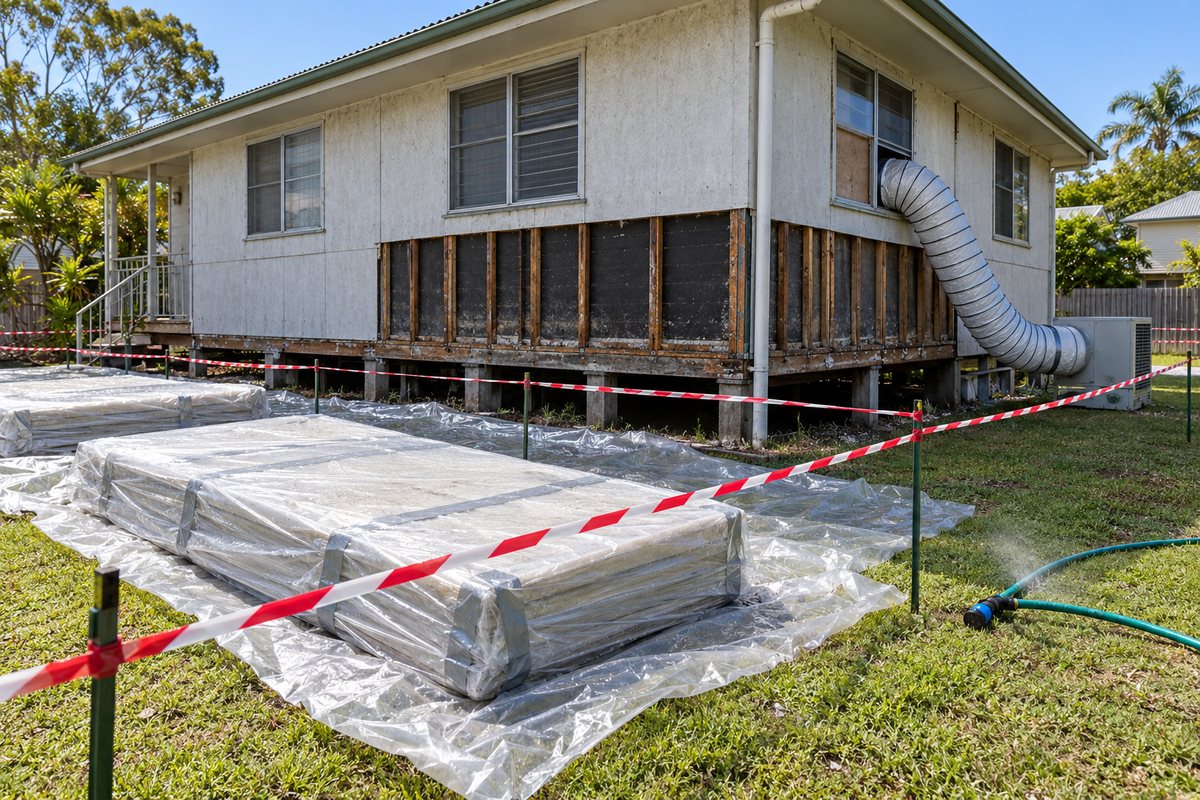
Sheets come off whole wherever possible, wet down to keep fibre out of the air, and are not broken, cut or dropped. They are wrapped in two layers of 200 micron plastic, taped, and labelled CAUTION ASBESTOS. Asbestos never goes in a general skip or a wheelie bin, and a load found mixed into demolition waste at the tip attracts a contamination fee on top of everything else. Commercial transport of asbestos waste needs waste tracking regardless of quantity, and anyone carrying more than 175 kilograms as a business needs an environmental authority. The transport rules are on the Queensland asbestos transport page.
In the Bundaberg region there is only one place it can go: the Bundaberg Waste Facility at 46 University Drive. Qunaba, Tirroan, Childers and the smaller rural facilities do not accept it. University Drive takes wrapped non-friable asbestos generated within the region, open Monday to Friday 7 am to 5 pm and weekends 8 am to 5 pm. From 1 July 2026 the charge is $208 a tonne with a $45 minimum. Loads over 10 cubic metres need prior notification to council, and friable material is accepted only between 8.30 am and 3.30 pm, wet down, for special burial. The council's acceptance rules are on the waste acceptance page and the fees on the 2026-27 waste fees sheet.
The state levy ($135 a tonne in 2026-27, higher for regulated categories and rising by $10 a year) applies to landfill in the Bundaberg region; ask council how it is reflected in the gate fee. Because sheet is thin, the asbestos tonnage on a house is usually small; the labour of removing it safely is where the cost sits. What happens to the waste covers the other streams.
How the removal stage fits a demolition
For a full house demolition the removal is done after the survey and after services are abolished, since the removalist needs the power off too, and before the WHSQ demolition notice period runs if the structure is six metres or more. A sensible timeline is survey in week one, Form 65 lodged as soon as the removal is scoped, removal and clearance the following week, and machine day after that. For a strip-out or partial demolition the same steps apply to whatever is being removed, and a bathroom strip-out in a 1960s house is very often licensed Class B work on its own. For a shed or garage the corrugated roofing and wall sheets are the usual find.
Ask any removalist for their WHSQ licence number and class, the survey register they are pricing against, and who will issue the clearance. Ask the demolition contractor how they will confirm the clearance before machine day. Those three questions separate a compliant job from a quick one. Request a quote and the local contractor will scope both stages together.
What this page cannot do
This page cannot tell you whether your house contains asbestos. Only a survey with laboratory analysis of samples can do that, and the presumption for pre-1990 buildings stands until it is done. It cannot tell you whether a specific item is friable or bonded, which decides the licence class and the price; condition changes with weather, fire and age. It cannot quote a removal price. It cannot stand in for the Form 65 notice, the removal control plan or the clearance certificate, each of which is a legal document prepared by the licensed removalist or an independent person. If you have found damaged material in an occupied house, do not disturb it; contact a licensed removalist and read the WHSQ guidance before anything else.
Check the current rules before you rely on this
This page describes how asbestos is surveyed, removed, cleared and disposed of before demolition in the Bundaberg region. It describes the rules in general terms as they stood in October 2026. Standards, forms, thresholds and fines change.
The authoritative sources are Workplace Health and Safety Queensland, asbestos removal licences, Workplace Health and Safety Queensland, asbestos notifications, asbestos.qld.gov.au, asbestos removal control plans, asbestos.qld.gov.au, clearance inspections and certificates, asbestos.qld.gov.au, transporting and disposing of asbestos waste and Bundaberg Regional Council, waste categories and acceptance. Where anything here differs from those sources, they are right and we are not.
We are not building certifiers, engineers, planners or lawyers. For what applies to your property, ask a licensed building certifier or ring Bundaberg Regional Council on 1300 883 699.
Accurate at the time of writing, October 2026. Always check the source before relying on it.