What a full house demolition covers in Bundaberg
A full house demolition means the whole dwelling comes down and leaves the site, along with its stumps, footings, slabs, paths, sheds and the wastewater system if there is one. The block is then filled where the ground was opened, graded and left level. Council's April 2026 removal policy requires a removal site to be cleared of debris, stumps, foundations and wastewater systems, and builders expect the same of a demolished block before they quote on a new home. What happens before that depends on what sort of house you have, because the region's housing stock falls into three broad groups.
The first group is the high-set timber Queenslander on stumps. These are common in Bundaberg East, Bundaberg South, North Bundaberg and the older streets of Childers and Gin Gin. They are hardwood frames clad in weatherboard or chamferboard, roofed in corrugated iron, standing on timber or concrete stumps. They hold a lot of salvageable hardwood, and because they sit high they are the houses most often moved rather than demolished. If yours is one of these, read our guide to demolishing or removing a Queenslander before you decide.
The second group is the post-war fibro house. Walkervale, Avoca, Kepnock and parts of Bargara broadly grew in the 1950s and 1960s, with Avenell Heights following from the late 1960s, and much of that housing is low-set timber or steel frame clad in fibre cement sheet. WHSQ presumes asbestos in any building built before 31 December 1989 until a sample shows otherwise. For these the asbestos removal stage comes first and takes longer than the machine work that follows.
The third group is brick, either brick veneer on a slab or double brick. These are heavier, produce far more rubble by weight, and the slab and footings have to be broken out with a hammer attachment rather than pulled. Weight matters because construction and demolition waste is charged by the tonne at the council facility, and clean concrete goes at a lower rate when it is kept separate from everything else.
The sequence, step by step
Demolishing a house is building work under the Building Act 1975, so it needs a building approval before anything is touched. In Bundaberg that approval comes from a QBCC-licensed private building certifier, not the council, which stopped certifying in September 2015. The certifier checks the planning overlays that apply to your lot. If the house is a Victorian, Federation or Interwar building in a mapped neighbourhood character area, or one of the region's 79 local heritage places, a development application to council is needed first and the certifier will tell you so. See heritage and character rules for how that works. Under the Building Act the work must substantially start within two months of the approval and be finished within a year, with one extension of up to six months available from council; the certifier confirms the current conditions when the approval is issued.
While the approval is being arranged, the asbestos survey happens. A competent person inspects and samples the house and writes a register of what contains asbestos and where. That register sets the scope for the licensed removal that follows. Removal of more than 10 square metres of bonded sheet needs a Class B licence, any friable material needs Class A, and licensed removal is notified to Workplace Health and Safety Queensland on Form 65 at least five days before it starts. The removalist works to a removal control plan and the job ends with a clearance certificate from an independent person. Asbestos removal before demolition covers this stage in detail.
Services are abolished at the same time. Electricity removal is requested through your retailer, and Ergon in urban areas aims to remove the service line within 20 business days. The 2026-27 Ergon charges are $485.15 for service line removal and $107.33 for meter removal, both ex GST and billed through the retailer. Demolition must not start until Ergon has confirmed in writing that the supply is gone; a contractor who starts on a verbal assurance is taking a risk with a live line. Water and sewer are disconnected only by council staff, applied for on the Notice to Service Provider form, and if the house is on reticulated natural gas the disconnection goes through Australian Gas Networks. NBN lead-in removal is quoted case by case. Every service is off before the machine arrives.
The contractor must hold a WHSQ demolition work licence. Queensland licenses demolition under the WHS Regulation 2011, and the exemption for domestic houses falls away as soon as load-shifting machinery is used. Since nobody pulls a house down by hand, in practice every house demolition here is licensed work. If the structure is six metres or more high, which a high-set Queenslander often is at the ridge, the contractor also lodges a demolition notification with WHSQ at least five days before starting. You can read the licence rules on the WHSQ demolition licence page and the notification rules on the demolition notifications page.
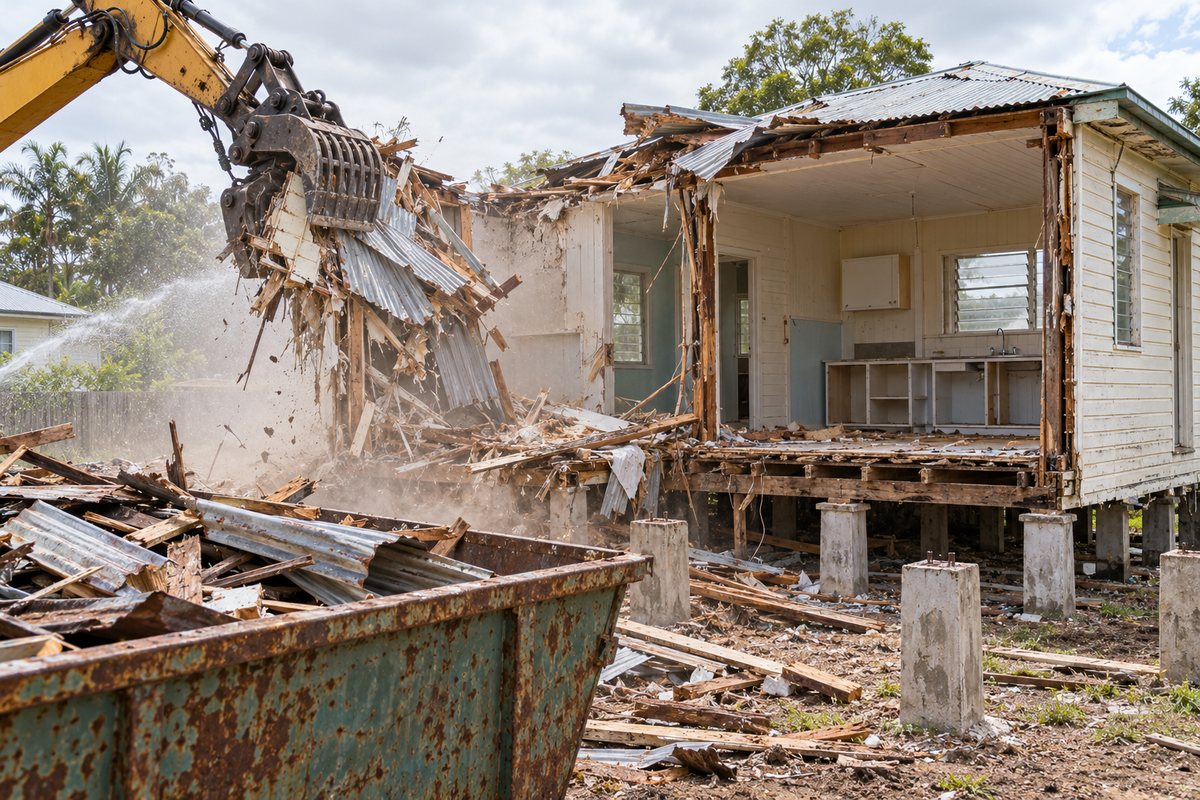
Salvage comes before the machine. Hardwood flooring, joists, French doors, windows, iron, stumps caps and fittings are worth stripping from a Queenslander and most contractors will either credit them against the price or let you keep them. Then comes machine day, usually a 13 to 20 tonne excavator with a grab, a water hose on the dust, and tippers or skips cycling to the tip. A timber house is often down in a day; brick takes longer. Stumps and footings come out next, the holes and any slab excavation are backfilled, and the block is graded. Where a septic or wastewater system exists it is pumped out, removed and the hole filled. Council's April 2026 removal policy requires a removal site to be cleared of debris, stumps, foundations and wastewater systems, and builders expect the same of a demolished block.
| Stage | Who does it | What it needs |
|---|---|---|
| Building approval | Private certifier | Overlay check, DA first if heritage or character |
| Asbestos survey and removal | Licensed removalist | Form 65, control plan, clearance certificate |
| Services abolished | Retailer, Ergon, council, AGN | Ergon written confirmation before any work |
| WHSQ licence and notification | Demolition contractor | Form 65 if 6 m or higher |
| Salvage and machine day | Demolition contractor | Water on the dust, sorted loads |
| Stumps, footings, fill and level | Demolition contractor | Clean fill, graded site |
What Bundaberg adds to the job
Ground conditions change across the region and they change the price of the last stage. From The Hummock through Bundaberg to the coast at Bargara the Woongarra red volcanic loams are deep and well drained; stumps and footings lift cleanly and the holes backfill easily. On the Burnett and Kolan river flats, North Bundaberg, Fairymead and Bingera, the grey alluvial clays are heavy, hold water after rain and bog machinery. A wet week can stop a job on the flats where the same week on the red soil would not. On the forest flats to the north the Gooburrum sandy loams sit between the two.
The flood overlay is the other thing a certifier will look at on the flats. The Burnett River peaked at 9.53 metres in January 2013, the highest on record, and over 4,000 homes were inundated with about 5,000 people evacuated from North Bundaberg. It rose above the 7.40 metre major level again in March 2026. Where the flood overlay triggers code assessment, council charges no fee for that trigger; the certifier confirms what the overlay means for the demolition and the rebuild, which will carry floor height conditions. Read demolition on the flood flats for the local picture.
Termites are a problem throughout Queensland and the Bundaberg region is no exception. A termite-damaged frame can collapse unpredictably during demolition, so a contractor who finds live activity will change the pull sequence. The Queensland variation of the National Construction Code requires termite management with a 50-year design life on the new house, so stumps and old timber are cleared completely rather than left in the ground as a food source. Roofs here are also fixed for the certifier's wind region, at the B/C boundary, which sets the tie-down requirements.
Where the waste goes
Sorting on site is what keeps the tip bill down. From 1 July 2026 the Bundaberg Waste Facility at 46 University Drive charges $359 a tonne for construction and demolition waste with a $45 minimum, $240 a tonne for clean concrete, $160 a tonne for green waste and takes clean fill under 100 millimetres free. The state levy ($135 a tonne in 2026-27) applies to landfill in the Bundaberg region and rises by $10 a year; ask council how it is reflected in the gate fee. Asbestos goes only to University Drive at $208 a tonne. Qunaba at Bargara takes loads up to three cubic metres from vehicles under eight tonnes, which suits a ute load of salvage but not a demolition tipper. What happens to the waste explains the sorting in detail.
What a house demolition does not include
Unless they are written into the quote, the following are usually outside the scope of a demolition contract. The building certifier's fee and any council development application fee are paid by you to them. Ergon and council disconnection fees are billed to you through the retailer and the council. Tree removal is separate work and on some lots a permit may be required to clear protected plants, so ask before assuming a tree can go. Imported fill beyond what the stump and slab holes need is extra. Soil testing, a new survey and a site classification for the next house are the builder's job, not the demolisher's. Road reserve use for a skip, a crane or traffic management needs a council permit at $550 for 2026-27, renewal $183. Our checklist before you start lists all of these so nothing is forgotten, and the cost guide explains what moves the price.
What this page cannot do
This page cannot tell you whether your particular house needs a development application, how high the new floor will have to be on a flood lot, or what the certifier will charge. Those are decisions a QBCC-licensed building certifier makes after looking at your title, the overlay maps and the house itself. It cannot confirm your house is free of asbestos; only a survey by a competent person can do that. It cannot quote a price, because the price depends on the structure, the soil, the access and what the survey finds. It cannot replace the written confirmation from Ergon that supply has been abolished. Use it to understand the sequence, then ask for a quote and let the contractor and certifier confirm the details for your block.
Check the current rules before you rely on this
This page describes how a full house demolition is approved, staged and completed in the Bundaberg region. It describes the rules in general terms as they stood in October 2026. Standards, forms, thresholds and fines change.
The authoritative sources are Workplace Health and Safety Queensland, demolition work licence, Workplace Health and Safety Queensland, demolition notifications, Building Act 1975 (Queensland), Building Act 1975 section 71, when demolition and removal must start and be completed, Bundaberg Regional Council Amenity and Aesthetics and Removal or Rebuilding Policy 2026 and Ergon Energy, removal of an electricity connection. Where anything here differs from those sources, they are right and we are not.
We are not building certifiers, engineers, planners or lawyers. For what applies to your property, ask a licensed building certifier or ring Bundaberg Regional Council on 1300 883 699.
Accurate at the time of writing, October 2026. Always check the source before relying on it.